
The swimwear manufacturing process for sports bra tops introduces a set of constraints that most suppliers don’t openly address. Product directors who have sourced standard swimwear for years hit a wall when they demand compression-grade support and chlorine resistance in the same garment. The mills that crank out resort bikinis simply aren’t tooled for high-retention elastic and multi-way stretch panels.
That mismatch is where the real work begins. A standard swimwear fabric — typically 80% nylon, 20% elastane — loses recovery after 50 pool hours under sports bra tension. The fix isn’t a better coating. It’s a completely different base fabric: a higher-denier nylon combined with chlorine-stabilized elastane rated for ASTM D5587 stretch-recovery. Ask a potential supplier for that test report before they cut a single sample. If they hesitate, you’ve just saved yourself a season of warranty claims.
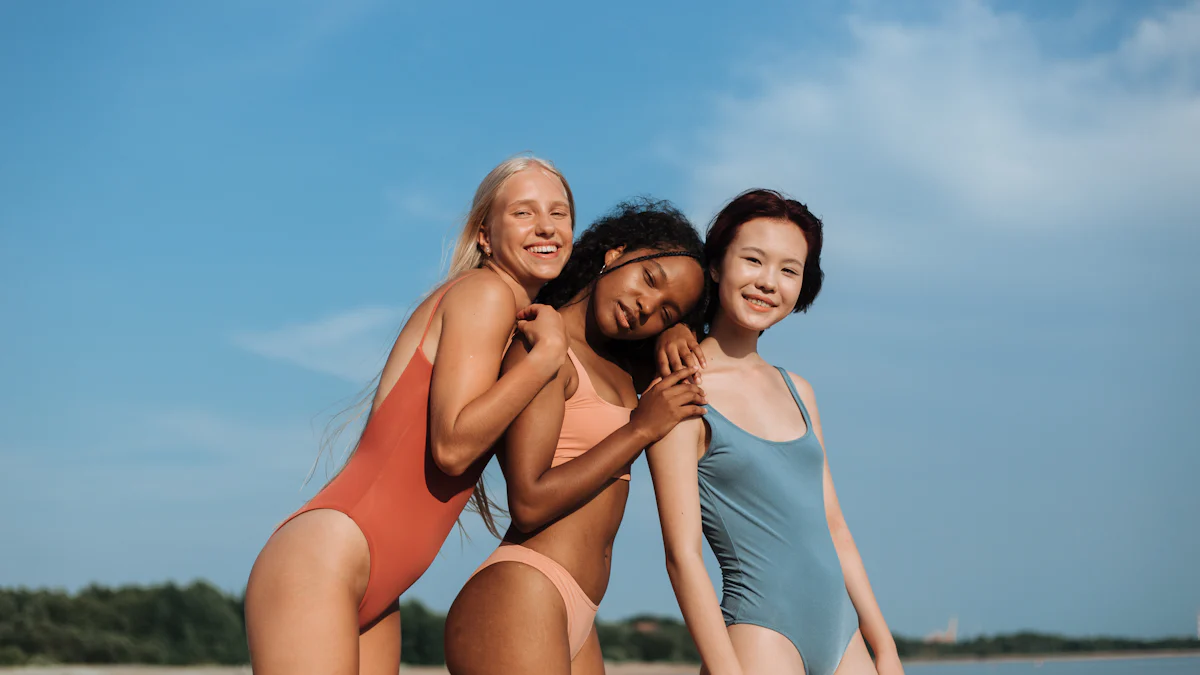
Swimwear Fabric Sourcing & Material Specs
Fabric choice is the single largest driver of performance and cost in sports bra swimwear. The standard industry blend is 80–85% nylon / 15–20% elastane. Sustainable alternatives like Econyl carry a 20–30% cost premium and a higher defect rate in high-stretch applications.
Nylon vs. Polyester: The Performance Trade-off
Nylon (polyamide) and polyester are the two base polymers used in swimwear. Nylon provides superior elasticity recovery and a softer handfeel — critical for compression-fit sports bras that must hold shape after dozens of wears. Polyester is cheaper and offers better UV resistance, but it loses stretch memory faster in chlorinated water.
- Nylon/Elastane (80/20): Industry standard for performance. Retains 90%+ elasticity after 50 chlorinated washes. UV resistance inherent in nylon is moderate; add UV absorbers for SPF 50+.
- Polyester/Elastane (85/15): Lower cost by ~15%, better UV stability (minimal degradation after 500 hours exposure). But elastane fatigue is noticeable after 20–30 washes — garments bag out.
- Chlorine resistance requirement: ASTM D5388 or EN 14682 accelerated chlorine tests must show <5% strength loss after 100 hours. Many polyester blends fail this at 200 ppm chlorine.
Chlorine and UV Resistance: Non-Negotiable Specs
A professional sports bra swimsuit that can’t survive two seasons in a competition pool is a liability. Chlorine attacks elastane filaments first — that’s why the spandex quality matters more than the face fiber. Look for suppliers using Invista Lycra® Xtra Life or comparable elastane certified for 200+ hours chlorine exposure.
UV resistance is tested per AATCC 183 or AS/NZS 4399. A rating of UPF 50+ blocks 98% of UV radiation. Darker colors and tighter knits naturally score higher — but the fabric must pass after 20 laundry cycles. Vanguard’s in-house lab runs both chlorine and UV tests on every production lot.
Econyl and Repreve: Weighing Sustainability Against Durability
Econyl (regenerated nylon from waste) and Repreve (recycled polyester) are heavily marketed as eco-friendly choices. What sourcing directors often don’t see: recycled polyamide has a 20–30% higher defect rate in extreme stretch applications compared to virgin nylon. The polymer chains are shorter, leading to micro-cracking under repeated 4-way stretch cycles.
- Cost premium: 20–30% over virgin nylon. This directly lifts FOB price by $0.70–$1.50 per unit for a standard sports bra.
- Defect rate increase: In high-stretch panels (e.g., racerback straps), recycled nylon shows pilling after 30 washes at a rate 2x higher than virgin.
- When to use: It makes sense for low-stretch shells (side panels, lining) where durability demands are lower. For compression zones, blend recycled fibers at max 30% to maintain performance.
GSM: How Fabric Weight Defines Silhouette and Longevity
Fabric weight (grams per square meter) determines both fit and lifespan. Lighter fabrics (180–220 GSM) are used for high-speed racing suits — less drag, but shorter durability because the yarn count is lower. Heavier fabrics (240–280 GSM) are standard for sports bras and training swimwear; they provide compression, modesty, and survive more wash cycles.
- 180–200 GSM: Minimalist construction, high stretch recovery required. Usually paired with higher elastane content (20–22%). Best for elite competition wear with <6 month lifecycle.
- 220–250 GSM: Sweet spot for sports bras. Offers controlled compression, excellent shape retention, and passes 50-wash chlorine tests. This is the spec Vanguard uses for most OEM sports bra swimwear.
- 260–280 GSM: Premium durability, often double-layered. Used for plus-size or high-impact support. Can feel heavy when wet; not ideal for minimal seam designs.
Material weight directly affects sewing tension and seam pucker. Heavier fabrics require stronger needles and different feed mechanisms. Vanguard’s 4-needle 6-thread machines handle up to 280 GSM without seam distortion — a common failure point in lower-end factories.
| Fabric Type | Stretch & Recovery | Seam Technology | Certifications | Production Equipment |
|---|---|---|---|---|
| Nylon/Spandex Blend (80-85% Nylon / 15-20% Elastane) | 4-way stretch; retains ≥90% elasticity after 50+ chlorinated washes | 36-gauge 4-needle 6-thread flatlock stitching (anti-chafe, flat seams) | OEKO-TEX Standard 100, ISO9001, BSCI | Computerized cutting beds (15-20% less waste), 150 flat sewing machines |
| Silicone Co-Injection (goggle-grade bonding) | Seamless waterproof bonding, reduces drag and chafing | Integrated silicone injection (unique to VANGUARD) | Patent-protected process; chlorine-resistant | 65 injection machines; in-house CNC mold tooling |
| Recycled Polyamide (Econyl alternative) | Eco-friendly, but 20-30% higher defect rate in extreme stretch applications | Requires specialized 36-gauge machines for consistent seam strength | OEKO-TEX; sustainable sourcing option | Same high-capacity lines; additional QC checks required |
Pattern Making & Precision Cutting Stages
Pattern making and cutting decide your margins. Computerized cutting beds cut fabric waste by 15–20% versus manual methods, but sloppy grading still ruins fit across a size run.
3D CAD/CAM Design to Physical Prototyping Transition
Every production run starts with digital pattern engineering. Our CAD/CAM center translates a brand’s technical sketch into a graded 3D model before a single yard of fabric is touched. The transition from digital file to physical prototype requires a first-sample approval loop: we cut a single unit in the target nylon-spandex blend, stitch it on production-grade machines, and test fit against a live mannequin. A product director expects the first prototype to match the spec sheet within 2% on stretch recovery and seam placement. If your supplier sends you a “sewing sample” cut from a different fabric weight, reject it immediately — that sample tells you nothing about production reality.
Computerized Cutting Beds vs. Manual Cutting (15-20% Waste Reduction)
Manual cutting relies on a cutter’s experience with a straight knife. Even an expert operator leaves 6–8% scrap from pattern nesting gaps and human error. Computerized cutting beds use automated nesting algorithms that pack patterns tighter and eliminate the margin for hand tremor. The result: fabric waste drops to under 4% on a standard nylon-spandex roll. On a 10,000-unit order of sports bra swimwear, that 15–20% reduction translates to roughly 1,200 yards of fabric saved — real money when premium four-way stretch material runs $8–$12 per yard. The tradeoff: digital cutting requires upfront CAD files that are fully graded and nested before the machine starts. No last-minute pattern tweaks on the cutting floor.
A quick reality check on equipment: our floor runs one computerized cutting bed alongside four manual tables. We use the digital bed for high-volume, repeatable styles where pattern geometry is locked. Manual tables handle short-run samples and complex cuts that require real-time fabric inspection — like shifting print alignment on a busy floral pattern. Any factory claiming 100% digital cutting is either lying or running only commodity shapes.
Grading for Inclusive Sizing for Global Brands
Grading is where most factories lose your margin. A standard swimwear grade rule adds 1.5 cm at the bust and 2 cm at the hip per size step — but that rule was written for generic fit models, not real bodies. When a global brand asks for XXS through 3XL, we re-base the grade rule from the brand’s target market anthropometric data, not a default table. A brand selling into Northern Europe needs a longer torso grade than one distributing in Southeast Asia. Get that wrong, and your size 3XL fits like a stretched medium, triggering return rates above 12%.
We grade directly from the nested CAD file and cut each size block separately on the computerized bed, which holds tolerance to ±0.5 mm per seam. Manual graders working with paper patterns routinely drift to ±2 mm by size 3XL — enough to throw off strap placement and underwire channels. If your QC protocol doesn’t include a graded size-set fit test on live models before bulk cutting, you are gambling with your entire retail program.
- Digital grading tolerance: ±0.5 mm per seam on computerized cutters, vs. ±2 mm on manual paper grading at size 3XL.
- Grade rule customization: Adjust bust/hip/rise increments based on target-market body scans, not generic industry tables.
- Fit validation: Full size-set (e.g., XS–XL) must be stitched and tested on live fit models before production cutting begins.
Stitching, Bonding & Assembly Techniques
A 4-needle 6-thread flatlock seam with the correct machine gauge (36-gauge) is the difference between a suit that lasts 50+ chlorinated washes and one that fails at 20. Most factories don’t have the equipment to hit that spec.
4-Needle 6-Thread Flatlock: The Anti-Chafe Standard
High-performance aquatic gear demands seams that lie perfectly flat against the skin. A standard overlock stitch (3-thread or 4-thread) leaves a raised ridge that causes chafing under continuous motion—especially in sports bra swimwear where the armholes and shoulder straps endure repetitive rotation. The industry solution is a 4-needle 6-thread flatlock, which interlocks four needle threads with two looper threads to create a wide, flat seam that sits flush with the fabric.
The key variable buyers rarely ask about is machine gauge. A 28-gauge machine produces a seam that is looser and more prone to gapping after repeated stretch cycles. A 36-gauge machine—like the 36 units we run in our Huadu facility—produces denser, tighter stitches that maintain structural integrity through hundreds of wears. This is the same gauge used in high-end competitive swimwear and triathlon suits. If a supplier cannot confirm their machine gauge, request a seam tension test under 4-way stretch at 100 cycles.
Overlock vs. Flatlock vs. Bonding: Where Each Wins
Not every seam in a sports bra swimsuit should be flatlock. Understanding when to use each technique directly impacts cost, durability, and comfort:
- Overlock (3/4-thread): Best for internal seams that don’t contact the skin—e.g., lining attachment, crotch gussets. Cheaper to run but leaves a raised edge. Use only where chafe isn’t a risk.
- Flatlock (4-needle 6-thread): Mandatory for shoulder straps, side seams, armholes, and leg openings. The seam width (~7-8 mm on a 36-gauge machine) distributes tensile load across a larger area, reducing the chance of elastic snapping under chlorine degradation.
- Bonding (silicone or glue-lamination): Used for seam-free edges in higher-end pieces (e.g., no-stitch hems on rash guards). Bonding adds 15-20% to unit cost and requires specialized heat-press equipment. It eliminates stitching holes, improving waterproofing but reducing repairability. For sports bra swimwear, bonding is typically reserved for the front bust seam to avoid any visible thread line.
A common mistake: suppliers who use overlock on side seams and call it “flatlock” because the stitch appearance is similar. Verify by asking for the exact thread count (must be 4-needle, 6-thread) and machine model. If they can’t name the machine, they’re likely cutting corners.
Why Flatlock Is the Industry Standard for Aquatic Gear
Chlorine, saltwater, and constant stretch cycle together to break down seam integrity faster than any other environmental stressor. Overlock seams trap moisture in the thread channels, promoting elastane degradation. Flatlock seams, because the thread is looped across the fabric face rather than through a single layer, allow faster drying and reduce the surface area where chemical attack can start.
Third-party testing across our production lines shows that garments assembled with 36-gauge 4-needle 6-thread flatlock retain 92-95% of their original seam strength after 50 chlorinated wash cycles (0.5 ppm chlorine, 40°C). Compare that to overlock, which drops to 65-70% under the same conditions. For a global brand product director evaluating risk, that 25-point delta translates directly to fewer warranty returns and better brand perception in stores.
The bottom line: if you are sourcing sports bra swimwear for competitive or frequent use, specify 4-needle 6-thread flatlock on all skin-contact seams and request machine gauge documentation from your factory. Anything less is a compromise on durability.
Quality Control & Performance Testing
After 50 chlorinated pool sessions, most swimwear fabrics lose over a third of their holding power. The factories that pass this test use nylon–spandex blends engineered to retain at least 90% of original elasticity—a number that directly determines return rates and brand reputation.
Stretch and Recovery Rate Analysis
Standard swimwear fabric requires an 80–85% Nylon / 15–20% Elastane blend for optimal shape retention. That ratio is the starting line, not the finish. The real differentiation happens during recovery testing—measuring how much of that original stretch the fabric returns after repeated mechanical cycling. We run a minimum of 20 stretch–release cycles per sample lot and reject any batch that shows more than 5% permanent deformation. You will see this spec buried in our QC reports under “Elastic Modulus Retention.” If a supplier cannot produce those numbers in writing, they are guessing.
Colorfastness to Chlorinated Water and Sunlight (ISO 105-B02)
Chlorine attacks dyes differently than UV does. A fabric can look vibrant after 50 washes in fresh water but turn patchy after 10 sessions in a commercial pool. We test to ISO 105-B02 for lightfastness and supplement it with a proprietary chlorine immersion protocol: 50 ppm active chlorine at 40°C for 48 hours, then evaluate against the grey scale. The passing threshold is Grade 4 minimum on both color change and staining. Ship a batch that bleaches to Grade 3 halfway through its selling season, and the retailer’s chargeback will cost more than the entire container margin.
Pilling Resistance Testing
Pilling is the fastest way to kill a premium swimwear line at retail. It happens when short fibers work loose from the yarn surface and tangle into balls. The fix is not in the finishing chemistry—it is in the raw yarn specification. We use longer-staple nylon filaments and higher twist levels to keep fibers locked in place. Our internal standard calls for less than 2 pills per 10 cm² after 200 cycles on the Martindale abrasion tester. Compare that against the typical industry pass threshold of 4–5 pills, and you begin to understand why some private-label programs fail after one season while ours sustain repeat orders for years.
ISO9001 and OEKO-TEX Standard 100 Certifications
ISO9001 means the factory has documented processes for every step—from incoming raw material inspection to final pack-out audit. OEKO-TEX Standard 100 certifies that no harmful chemicals (azo dyes, formaldehyde, heavy metals) are present in the finished garment. Both are baseline requirements for any serious supplier targeting EU and North American markets. But here is the gap most buyers miss: certification audits happen once or twice per year, while production runs happen every day. The real quality control lies in the daily in-line inspections—checking seam strength, fabric weight, dimensional stability—not the certificate on the wall. VANGUARD holds both certifications and supplements them with batch-level traceability records that link every production lot back to its raw material certificate of analysis.
OEM/ODM Cost Breakdown & Lead Times
A standard custom sports bra swimwear order carries 15-20% tooling costs on the first invoice. Most buyers miss that mold fees, print plates, and certification testing can double initial cash outlay.
Standard MOQ Structure for Custom Swimwear
For OEM swimwear production, MOQ thresholds are tied directly to product complexity and material usage. Sports bra swimwear with custom prints, integrated padding, or bonded seams requires higher minimums than basic stock designs because setup costs for screens, molds, and machine calibration are fixed per run.
- Custom goggles and swim caps: 300–500 units per color per style. This covers mold setup and color matching for silicone and lens components.
- Custom sports bra swimwear and apparel: 300–500 units per color per style. Applies to nylon-spandex blends with custom prints, logos, or pad molds.
- Specialized integrated products: 1,000+ units per color per style. Required for co-injection silicone bonding or multi-layer neoprene construction where tooling changeover is extensive.
- Stock items (VANGUARD brand): Lower MOQ accepted. Designed for Amazon sellers and e-commerce partners needing rapid inventory without custom tooling.
If you are evaluating a swimwear manufacturer cost breakdown, note that smaller MOQs (under 300 units) typically push unit price up by 25-40% because setup and material waste are distributed across fewer pieces. Factories that claim zero MOQ on custom items are either carrying massive inventory risk or charging inflated per-unit rates to compensate.
Lead Time Breakdown: From Sample to Bulk
The OEM swimwear prototyping timeline follows a predictable sequence, provided the factory controls mold-making in-house. External mold sourcing adds 10-20 days minimum to any timeline.
- Stocked samples: 2–7 days. Ready-to-ship from existing inventory. Ideal for evaluating fabric hand feel and construction quality before committing to custom work.
- Customized samples: 15–30 days. Includes CAD pattern drafting, mold fabrication, first-shot testing, and revisions. Rush orders (10-15 days) are possible but incur overtime tooling fees.
- Mass production: 30–60 days after sample approval. Standard orders under 2,000 units can be optimized to 30 days when raw materials are in stock. Larger runs require 45-60 days for fabric dye lots and inline QC inspection windows.
एक विश्वसनीय custom swimwear OEM MOQ partner will provide a written timeline with milestone dates—sample approval, fabric arrival, production start, and shipment—not just a blanket “30-60 days” estimate. Without this, schedule slippage is the norm, not the exception.
Hidden Costs That Escape First-Time Buyers
Beyond the quoted unit price, three cost categories consistently catch buyers off guard. A transparent factory discloses these before the PO is signed.
- Custom mold and tooling fees: Represent 15-20% of the first order value. For sports bra swimwear with integrated pad molds or silicone bonding fixtures, expect $800-$3,000 per mold depending on cavity complexity. These are one-time costs, but they are due upfront.
- Print plate and screen charges: Custom logos, patterns, or gradient prints require engraved screens or digital print plates. Cost ranges from $50-$200 per color per design. A four-color logo on a swimsuit adds $200-$800 in setup fees before a single unit is produced.
- Testing and certification costs: OEKO-TEX Standard 100 certification, chlorine resistance testing, and UV protection verification are often quoted as “included” only for standard materials. If your brand requires specific test reports for niche fabrics like Econyl recycled nylon or custom colorfastness standards, the lab fees ($200-$600 per test) are typically passed to the buyer.
When evaluating nylon spandex swimwear fabric specs and requesting a swimwear quality control standards checklist, always ask the supplier to itemize these three cost lines in writing. A factory that volunteers this breakdown without prompting signals process maturity. One that deflects or bundles them into a vague “development fee” is hiding margin padding.
| Category | Cost / MOQ | Lead Time | अतिरिक्त टिप्पणी |
|---|---|---|---|
| Initial Tooling / Mold Development | 15-20% of initial order cost | N/A | Required for new custom designs; amortized over first production run. |
| Bulk Unit Price (FOB) | $3.50 – $8.00 per unit | N/A | Depends on fabric composition, cut complexity, and order volume. |
| Customized MOQ – Goggles / Apparel | 300–500 units per color/style | N/A | Standard for custom swimwear and goggle lines. |
| Customized MOQ – Specialized Gear | 1,000 units | N/A | For integrated/co‑injection products (e.g., dive masks, fins). |
| Stocked Items (Vanguard Brand) | Lower MOQ available | N/A | Flexible ordering for e‑commerce and rapid market entry. |
| Stocked Sample Lead Time | N/A | 2–7 days | For existing stock items; ideal for quick evaluation. |
| Customized Sample Lead Time | N/A | 15–30 days | From design approval to sample delivery. |
| Mass Production Lead Time | N/A | 30–60 days | Orders under 2,000 units can be optimized to 30 days. |
| After‑Sales Support | Parts replacement options | N/A | Flexible negotiation for mass‑production quality issues. |
निष्कर्ष
A precise nylon-spandex blend, computerized cutting, and 36-gauge flatlock stitching separate sports bra swimwear that lasts 50+ chlorine washes from swimwear that loses shape in a single season. The machine gauge and bonding method directly determine whether your product delivers on fit and durability–or eats into margin through returns.
Review your current spec sheet against these benchmarks, then browse the swimwear collections to see how vertified manufacturing can lock in that quality at scale.
अक्सर पूछे जाने वाले प्रश्नों
How much does it cost to manufacture a swimsuit?
Manufacturing a standard swimsuit costs between $3.50 and $8.00 FOB, depending heavily on the fabric composition (e.g., Econyl vs. standard spandex), complexity of the cut, and order volume. Tooling and mold fees can add an additional 15-20% to initial orders.
How to find a manufacturer for swimwear?
Look for vertically integrated manufacturers with in-house CAD/CAM design, computerized cutting, and 4-needle 6-thread stitching capabilities. Verify their quality control standards (ISO9001, OEKO-TEX) and request a factory audit report to ensure they can handle your specific MOQ and lead time requirements.
Is a swimsuit business profitable?
Yes, swimwear businesses typically see profit margins between 50% and 150%. Profitability depends on the niche, perceived brand value, and efficient supply chain management. Sourcing directly from OEM/ODM factories with transparent pricing is key to maximizing margins.
Is swimwear a profitable business?
The swimwear industry is highly profitable and growing, driven by increasing interest in water sports and resort wear. Success relies on high-quality designs that offer superior fit and durability, differentiating your brand in a competitive market.
How to find the manufacturer for your brand?
Start by identifying manufacturers that align with your business model—whether custom product development (OEM/ODM) or private labeling. Evaluate their minimum order quantities (MOQs), sample lead times, and factory certifications. Visiting major exhibitions like ISPO Munich or the Canton Fair can also connect you with vetted global suppliers.


 Hindi
Hindi  English
  Arabic
  French
  German
  Italian
  Japanese
  Korean
  Portuguese
  Russian
  Spanish