...

중국의 수영 및 다이빙 장비 브랜드 제조업체, 도매업자, 이후 OEM 프로젝트 1993.

소싱 & OEM

Competition Swim Goggles Wholesale: MOQ, Club Team Programs, and Pricing

Competition Swim Goggles Wholesale: MOQ, Club Team Programs, and Pricing

A swim club does not order goggles the way a beach shop orders snorkel sets. Team orders arrive in waves before the competitive season, every age group needs a different fit, and a single fogging complaint circulates through fifty parents before your restock window even opens. For wholesalers supplying clubs, 팀, and competition organizers, the commercial risk sits less in the product itself than in how the order is structured: minimum quantities, color runs, size tiers, and replenishment terms.

This guide walks through the wholesale mechanics of competition swim goggles specifically. What separates a racing goggle from a general-admission goggle on a purchase order, how MOQs actually work when you buy them by the hundred, how to assemble a club team program without accumulating dead stock, and how to verify a manufacturing partner before you commit a season’s budget.

주요 시사점

  • Competition goggles are defined by a low-profile seal, a narrow lens, and a durable anti-fog treatment; those three attributes drive most of the cost difference against recreational models.
  • A typical factory MOQ for goggles is 300 pieces per color on stock tooling; going off-palette or changing packaging is what pushes an order into custom territory.
  • Team programs work best as three tiers: learn-to-swim, junior racing, and senior racing, each with its own size run and price band.
  • Sample turnaround of 2 에게 7 days on stock items and 24 에게 48 hours of Design for Manufacturing (DFM) feedback on custom concepts lets you validate a program long before the season deadline.
  • Verification should cover three layers: management system (ISO 9001:2015, BSCI), 제품 규정 준수 (CE, FDA, OEKO-TEX 표준 100), and batch-level test reports for anti-fog duration, seal leakage, and strap pull strength.

What Separates a Competition Goggle From a Regular Goggle on a Purchase Order?

Retail buyers tend to describe racing goggles by look. Factory buyers describe them by specification, because that is where the returns either die or multiply.

Three attributes define the competition tier. 첫 번째, the seal: a low-profile silicone skirt that sits inside the eye socket rather than over it, which reduces drag and keeps water out during starts and turns. 두번째, the lens: narrow, available in clear for indoor training and mirrored or tinted for bright pool halls and outdoor meets. 제삼, the anti-fog treatment, which on serious racing models is either a durable applied coating or a molded-in solution integrated into the lens material during production.

The construction method matters as much as the parts. Liquid silicone rubber gaskets bonded to the polycarbonate lens by co-injection molding, rather than glued afterward, give the goggle its water-tight seal and its resistance to the chlorine abuse of a training season. Our factory built its goggle line around this patented silicone co-injection process precisely because the glued joints are where cheap competition goggles fail first. If you are comparing supplier quotes and one looks noticeably cheaper, check whether the skirt is co-injected or adhesively assembled before you celebrate the margin.

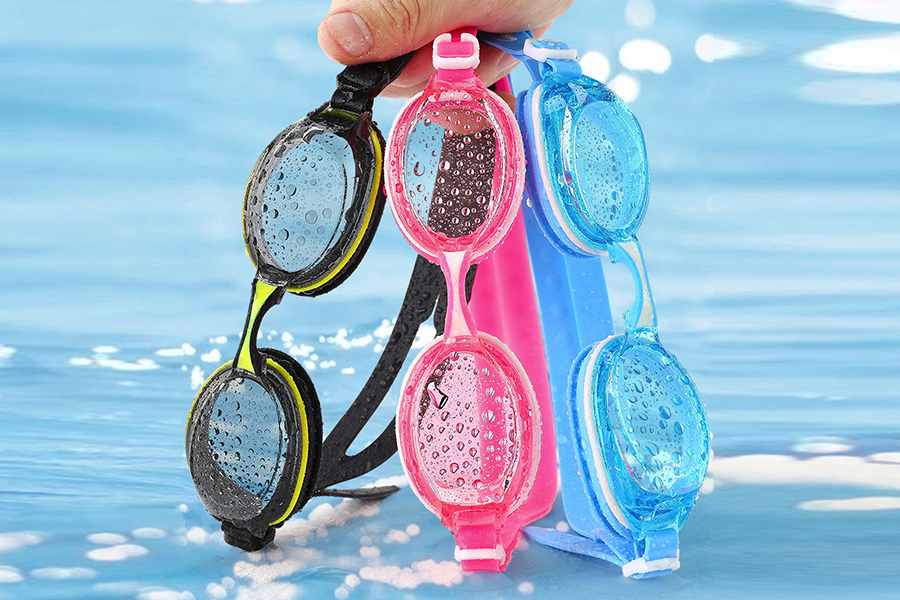
Three pairs of low-profile competition swim goggles arranged for a wholesale color lineup
Competition-grade goggles keep the same tooling across a color family, which is what makes mixed team orders practical.

For a broader breakdown of how racing models sit alongside other categories, our guide to the swimming goggle product range covers frame, 렌즈, and seal options in procurement terms.

How Does MOQ Work When You Buy Competition Swim Goggles Wholesale?

Minimum order quantity is the first number every wholesaler checks, and the first number most suppliers fudge. Here is how it works in practice on goggle tooling that already exists.

On standard models, a typical MOQ is 300 색상별로 조각. That per-color structure exists because injection molding runs by color batch: the machine clears one compound, then changes to the next. Within one color, you can usually mix models that share components, and many factories will split quantities across clear, tinted, and mirrored lens variants of the same frame. If a supplier quotes you “one stock keeping unit, 3,000 pieces minimum” for a simple color change, that is a red flag about their production planning, not about your order size.

The second tier is custom color. Matching a Pantone code takes the goggle out of the stock palette, so expect the same or slightly higher per-color quantity and a longer lead time for material preparation. The third tier is full custom: your frame geometry, your seal design, new tooling. That path starts with DFM feedback, which at a competent factory arrives within 24 에게 48 hours of submitting your concept, followed by prototyping that runs 15 에게 30 금형개발 포함 일수, then mass production at 30 에게 60 days for a first order and roughly 30 days for repeat orders.

Order program Typical commitment 리드타임 최적의 핏
Stock program 300 색깔 당 PC, mixed models within color 48-hour dispatch on in-stock lines; 샘플 2 에게 7 날 Season replenishment, test orders
맞춤 색상 / private label on stock tooling Per-color run on your palette 양산 30 에게 60 날; repeats around 30 날 Branded club programs
Full OEM with new tooling Mold project plus production commitment DFM in 24 에게 48 시간, prototypes 15 에게 30 날, then production House-brand racing lines

One commercial detail worth negotiating up front: repeat orders of standard private-label models should not carry mold fees again. Any tooling and original design work stays protected under non-disclosure agreements, which matters when your team program’s colorway is itself a selling point. If your priority is speed rather than customization, 그만큼 ready-to-ship catalog is built for exactly the first-tier scenario above.

How Should a Club Team Program Be Structured?

A team program is not one product; it is three, and the wholesalers who treat it as one end up with shelves of unsellable senior mirrors and parents complaining that nothing fits a seven-year-old.

The structure that works across most club environments runs like this:

Tier one: learn-to-swim and junior training (roughly ages 6 에게 12)

부드러운 실리콘 스커트, clear or lightly tinted lenses, a wide adjustable strap, and a price that survives being lost twice a season. Fit takes priority over optics; a junior goggle that leaks gets removed from the pool deck within a week, no matter how good the anti-fog is. Stocking interchangeable nose bridge sizes (small, 중간, large) on one frame lets you serve a whole age band with one purchase order.

Tier two: junior racing (roughly ages 12 에게 16)

The first real low-profile fit. These swimmers have the face dimensions of adults but budgets of juniors, so the durable anti-fog and a mirror option at a mid price point win this tier. This is where a mixed color run pays off: teams buy identity, and a school will commit to two hundred units if the color matches the cap.

Tier three: senior and masters racing

Low volume, high specification. Swimmers in this tier replace goggles on a schedule, complain knowledgeably about fog, and will pay for a molded-in anti-fog lens and a proper mirrored finish. Keep this tier shallow in stock and deep in specification.

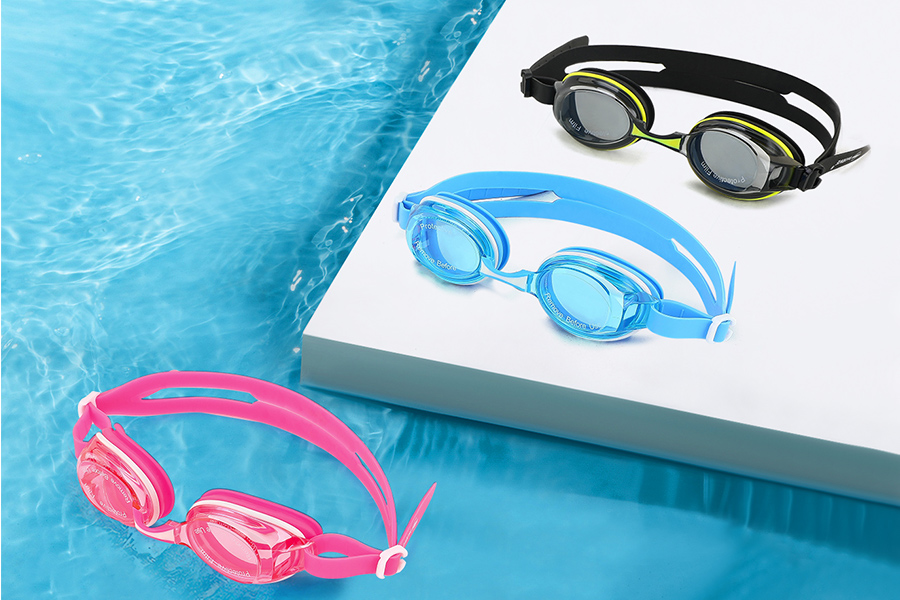
Black, pink and blue competition swim goggles showing the color range available for team orders
Club orders consolidate around two or three colors per season; per-color MOQ is designed around that reality.

A practical ordering rule for a first season: buy the junior tier in full size runs, the racing tiers in half-depth with a committed replenishment window, and expect the reorder cycle of roughly 30 days to land exactly once mid-season. For a consumer-facing view of what young competitive swimmers actually pick, the roundup of youth competitive goggle choices remains a useful shopping-list proxy for what your club customers will ask for.

What Drives the Price Ladder on Wholesale Competition Goggles?

Two goggles with identical photos can sit three price bands apart. The variables are consistent enough to model before you quote a team.

  • Lens treatment. Clear is the base. Tinted adds a small step. A quality mirrored or REVO-style finish is the largest single jump in the racing tier, and it is also the finish most prone to cosmetic rejects, which quietly raises your effective unit cost if the supplier’s QC is weak.
  • Anti-fog method. A coated lens is cheaper at the start and more expensive after ninety days of chlorine. Molded-in anti-fog costs more per unit and defends your return rate. Our breakdown of how anti-fog technology actually works covers the durability difference in testing terms.
  • Seal construction. Co-injected liquid silicone skirts versus glued assemblies separate the mid and premium bands.
  • 포장. A blister card with retail printing is a different unit economics conversation than bulk polybags with a team case carton, and it changes your shelf story at the club shop.
  • Documentation depth. Batches shipped with per-shipment test reports and traceable lot numbers cost margin to produce, and save margin every time a retail chain audits you.

What you should model is landed cost per sellable tier, not per unit. A 300-piece order of premium mirrors that only clears through tier-three swimmers costs you more per season than 900 mixed junior units that move through a club shop in six weeks. Competition goggles wholesale pricing rewards assortment planning more than unit-price negotiation.

How Do You Verify a Competition Goggle Supplier Before Committing?

Verification has three layers, and most buyers only ever check the first.

Layer one: the management system

Ask for the certificate, not the logo. ISO 9001:2015 tells you the factory documents its own processes; BSCI tells you the social-compliance side holds up under an audit, which chain accounts will care about before your first anniversary. A production base running its own injection line, with four production lines and 65 molding machines on site, is structurally different from a trader quoting someone else’s capacity.

Layer two: product compliance for your market

CE documentation for European distribution, FDA registration for the US market, 및 OEKO-TEX 표준 100 on the silicone that sits against a child’s eye socket. These are the compliance files a real supplier can send as documents, not descriptions. 우리의 certification and compliance overview lists what we hold and what we ship with orders.

Layer three: batch-level evidence

This is the layer that predicts your return rate. A quality inspection report should carry anti-fog duration data, seal and leak test results, and strap pull-strength numbers for the actual batch, not the model’s launch-day prototype. Ask for these on the sample order, before the season purchase, and compare them between suppliers. Long-term contract manufacturing for brands such as Speedo is reassuring exactly to the degree that it forced these reporting disciplines; ask any supplier which programs they have documentation habits from.

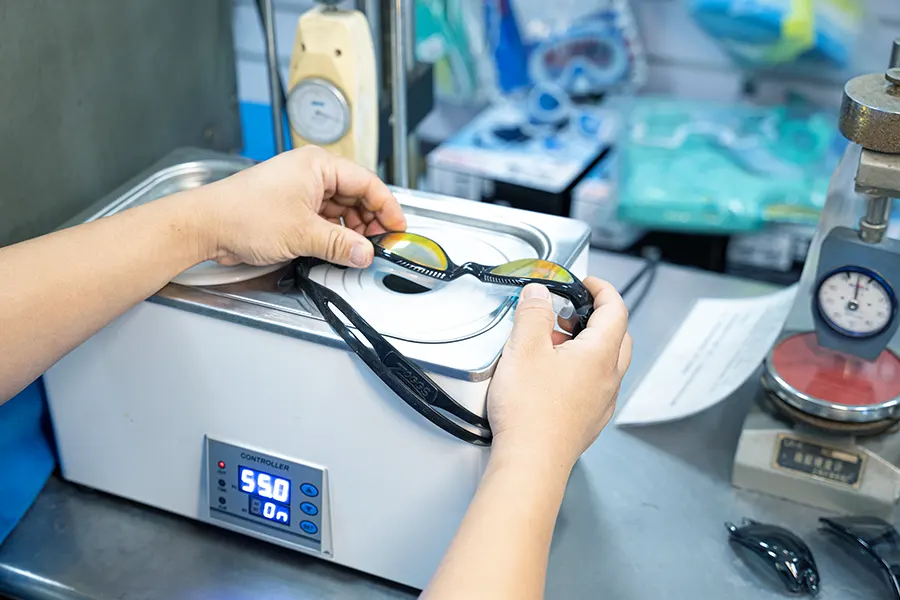
Quality control station inspecting finished swim goggles against batch test criteria
Batch inspection against written criteria is the difference between a supplier who tests and a supplier who claims.

For a wider view of how the supplier landscape looks, our survey of major swimming goggle suppliers explains where factories, traders, and brand houses actually differ on these three layers.

What Are the Failure Patterns That Kill a Season’s Margin?

Four show up repeatedly in post-mortems with team-channel sellers.

Fog by week six. Almost always a coated-lens purchase priced to win a quote comparison against a molded-in alternative. The parent never sees the specification sheet; they see the fog.

Strap failures on junior runs. Kids don’t adjust straps gently. If the buckle survived only cosmetic inspection, you will learn about it from returns with photos.

Missed season windows. A 45-day production slot quoted in April does not land a September club-fair program if the color approval loop takes three weeks of email silence. Confirm who chases approvals, and lock sample sign-off dates like delivery dates.

Dead colors. Teams order the club color, not the supplier’s palette favorite. Per-color MOQ is only dangerous when you pick colors for yourself instead of for a program that has already sold two hundred caps.

Planning a team or club goggle program? Send us your tiers, 그림 물감, and season deadline. We reply with a DFM-backed plan, sample options in 2 에게 7 days on stock models, and per-batch test documentation. Use the contact form to request a quote for your next season.

자주 묻는 질문

Can I split the 300-piece MOQ across models and lens types?

Within one color, 예. Most goggle factories run the skirt and lens as separate components, so a single color batch can cover several frame or lens combinations that share those parts. Splitting one order across entirely different tooling, or across colors, is what resets the count per line.

Do competition goggles need different certifications than regular goggles?

The regulatory category is the same, but the practical file set shifts. Mirrored and UV-treated lenses attract more documentation requests from European buyers, and anti-fog claims are the first place a chain auditor looks for test evidence. The baseline we ship includes CE and FDA documentation with OEKO-TEX Standard 100 on skin-contact silicone.

How deep should a first club-team order be?

Size the junior tier to registered membership plus a twenty percent buffer, hold the racing tiers shallow, and set a mid-season reorder checkpoint. With repeat production running around 30 days and stock dispatch in 48 시간, a program can be corrected after one meet instead of after the whole season.

Is a mirrored lens worth it for junior racers?

For outdoor meets and bright natatoriums, 예; it is also the cosmetic most often damaged by careless handling, so juniors in training should keep a clear pair as the default. A sensible team program sells both from the same frame family, which keeps your color-run quantities efficient.

What should the sample order include before I commit to a season?

At least one unit of every tier you plan to sell, the batch test report for the shipment those samples come from, and the packaging mock-up if you are running a branded program. On stock models that package lands in under a week; on custom concepts, expect the DFM loop first and a prototype in 15 에게 30 날.

이 기사를 공유하세요

수영 장비 프로젝트를 시작할 준비가 되었습니다?

제품 사양을 보내주세요., 목표 수량, 및 타임라인. 우리 수출팀은 영업일 기준 1일 이내에 가격에 대한 답변을 드립니다., MOQ, 그리고 리드타임.

견적 받기 제품 찾아보기
맨 위로 돌아가기
빠른 견적이 필요합니다? WhatsApp에서 수출팀과 채팅하세요.