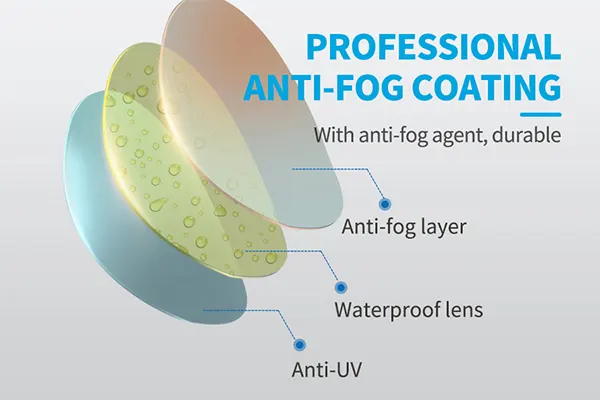
How Anti-Fog Coating Works on Swim Goggles: Chemistry and Longevity for Buyers
The coating chemistry behind anti-fog swim goggle lenses: how hydrophilic films stop droplet scatter, why the effect is sacrificial, what kills a…
Content Pillar
The coating chemistry behind anti-fog swim goggle lenses: how hydrophilic films stop droplet scatter, why the effect is sacrificial, what kills a…

A QA-focused testing protocol for snorkeling fins: cyclic blade flex, destructive strap pull tests, UV aging verification, how the tests map onto…
Rubber, TPR, silicone, or composite: how fin blade materials differ in elasticity, cold behavior, UV aging, and cost — and how to…
A buyer's teardown of snorkel valve technology — splash guard, dry-top float valve and base purge valve — with the failure modes,…
A procurement guide to dive mask material decisions — skirt compound, lens glass versus polycarbonate, and frame architecture — and how each…
Vanguard's patent-protected silicone co-injection process joins lens and silicone into one sealed unit, cutting leak-related returns to under 1%. Here is the…
Coated and molded-in anti-fog goggles solve the same problem with different durability profiles. This comparison helps retail buyers match the route to…
An explainer for swim retailers and e-commerce sellers on how anti-fog swim goggle technology works — the physics of fog, coated versus…
A technical buyer's comparison of freediving fin blade materials — carbon fiber, fiberglass, and polymer — across performance, durability, price tier, channel…
If you source dive masks for your brand or retail operation, you have probably encountered the term "silicone co-injection" — or its…
Learn how a swimming goggles factory manufactures top-quality, high-performance goggles.
Explore the evolution and benefits of custom full face masks featuring auto-clip buckle systems in the booming diving industry.