Technical buyers and pro dive shops do not choose freediving fins so much as they choose a blade material — the laminate decides the price band, the customer it attracts, and the way the fin behaves on the third hour of a training session. Carbon fiber freediving fins sit at the top of that decision, and the comparison against fiberglass and polymer is not a simple «better vs worse» question. Each material answers a different commercial brief, and stocking the wrong one for your channel means either leaving margin on the table or watching premium inventory gather dust.
This comparison lays out what each material actually does in the water and on your balance sheet: performance characteristics, durability behavior, price positioning, and the customer profile each tier serves. It closes with the verification steps that separate genuine material claims from marketing copy — the part of the sourcing process where most expensive mistakes are made.
Control de llave
- Carbon fiber offers the best stiffness-to-weight ratio and the fastest energy return — the premium tier for trained freedivers, at the highest price point.
- Fiberglass delivers most of the performance feel at a mid-tier price, making it the upgrade path for progressing divers.
- Polímero (termoplástico de alta resiliencia) is the volume engine: durable, asequible, and right for schools, alquileres, and entry retail.
- Material choice is channel strategy — match the ladder to who actually walks into your store or catalog.
- Verify blade claims with flex testing, weight measurement, and material documentation before committing to a production order.
How Blade Material Shapes Performance
Three physical properties do the work in any freediving blade, and every material choice is a trade-off among them. Weight determines how much mass your legs accelerate with each kick — and how the fin feels during a long surface swim back to the boat. Resilience, the speed at which the blade returns to its resting shape after bending, determines the «snap» a diver feels at the end of a kick cycle and how much of the stored energy actually converts to thrust. Fatigue behavior determines how many kick cycles the blade survives before its flex profile softens permanently.
A blade that is light but slow to return feels smooth yet inefficient; a blade that snaps hard but weighs heavy taxes the diver over a session. The engineering target across all three materials is the same — flex with high resilience at minimum weight — and the materials simply reach different points on that frontier. Our fin portfolio is tuned around exactly this balance of blade flexibility and thrust efficiency, with high-resilience polymer blades in the standard range and carbon fiber laminates at the top, sharing the same foot-pocket geometry across tiers.
Carbon Fiber Blades: What You Are Paying For
Carbon fiber composite blades are laid up as laminates — layers of woven carbon fiber impregnated with resin, cured under heat and pressure. The result is a blade with an exceptional stiffness-to-weight ratio: meaningfully lighter than polymer at equivalent stiffness, with a rapid, progressive snap-back through the kick. Trained freedivers describe the feel as responsive — the blade loads early in the downstroke and releases its energy in one clean pulse rather than a slow push.
para un comprador, carbon serves three commercial functions. It anchors the top of your price ladder and defines your store’s credibility with the enthusiast segment. It differentiates on sight — the visible weave pattern is a recognizable authenticity marker that customers actively inspect. And it carries the highest margin per unit, provided your channel actually reaches performance-oriented divers. The caution points are symmetrical: carbon is more expensive to produce and to stock, it demands careful handling in shipping (blade edges and tips are the vulnerable zones), and it punishes misuse — running a carbon blade into rocks or tank racks produces damage a polymer blade would shrug off.
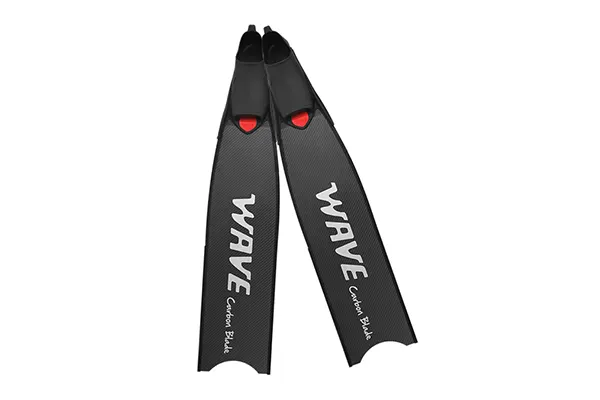
One specification question matters more than the rest when you evaluate carbon suppliers: the fiber layup and resin system, which determine whether the blade feels lively or dead in the water. Two visually identical blades can behave differently depending on layup orientation and cure quality — which is why sample evaluation (covered below) belongs in every carbon order, regardless of catalog claims.
Fiberglass Blades: The Middle Path
Fiberglass composite blades use the same laminate logic as carbon — woven glass fiber and resin — but with a heavier fiber and a different stiffness profile. The blade is somewhat heavier than carbon at comparable dimensions, with a softer, more progressive flex and a slightly slower return. En la práctica, many developing freedivers prefer that feel: the smoother power delivery is more forgiving of imperfect kick technique, and the performance gap matters less than the price gap for anyone not competing.
Commercially, fiberglass is the bridge tier. It lets a shop present a genuine upgrade story from polymer — lighter, livelier, visibly «compuesto» — without asking the customer to stretch to carbon pricing. It also carries a practical durability edge over carbon in rough-handling environments, because the tougher glass laminate tolerates knocks that would mark a carbon blade. Shops in destination locations with mixed-ability clientele often report fiberglass as their highest-turn composite tier for exactly this reason.
Polymer Blades: The Volume Engine
Polymer blades — injection-molded high-resilience thermoplastics — are the workhorse of the category. They are the heaviest of the three tiers and the slowest in snap-back, but they cost the least to produce, resist abrasion and UV exposure, and survive rental fleets that would consume composite blades. Stiffness decays slowly over seasons rather than catastrophically, so a school can predict replacement cycles instead of reacting to breakage spikes.
For wholesale planning, polymer is where the units are. School programs, resort water-sports desks, entry-level retail bundles, and promotional price points all pull from this tier. The polymer blades in our own range are engineered around the same flexibility-and-thrust target as the composites — with features like drainage channels and reinforced spines carried over from the long-blade designs — so entry customers get genuine engineering rather than a stripped-down shell. If your volume skews toward first-time buyers or rental operations, polymer is not the compromise choice; it is the correct one.

Carbon Fiber vs Fiberglass vs Polymer: The Comparison Table
| Atributo | Fibra de carbono | Fibra de vidrio | Polímero |
|---|---|---|---|
| Peso | Más ligero | Medio | Heaviest |
| Energy return (snap) | Fastest, most progressive | Liso, slightly slower | más suave, most forgiving |
| Durability in rough use | Bien, but sensitive to edge impact | Strong — tolerant of knocks | Strongest overall; slow stiffness decay |
| Price band | De primera calidad | Mid-tier | Entry / volumen |
| Best-fit customer | Trained and competition-adjacent freedivers | Progressing divers upgrading from polymer | Escuelas, alquileres, first-time buyers |
| Channel match | Specialist freediving shops | Destination dive shops with mixed clientele | Resorts, training operations, mass retail |
| Visual signature | Exposed carbon weave | Composite finish, often colored | Molded color, matte or gloss |
| Inventory risk | Highest — slow turn if channel is wrong | Moderado | Lowest — broad demand base |
Matching Material to Your Channel and Customer
The material ladder maps cleanly onto channel strategy if you let your customer data do the choosing. Rental and training operations should anchor on polymer: abuse tolerance and predictable replacement cycles beat performance prestige when the fin changes hands daily. Destination shops serving tourists and newly certified freedivers typically run polymer as the floor and fiberglass as the visible upgrade — a two-step story that suits mixed ability. Specialist freediving retailers carry the full ladder, with carbon as the flagship that certifies the shop’s seriousness and drives attachment sales of blades, bolsillos, and bags.
Two portfolio structures work in practice. The single-tier entry (polymer only) suits operations testing the category with minimal capital. The full ladder with interchangeable blades — pockets in every size, blades in all three materials — suits committed retailers, because customers upgrade within the ecosystem instead of leaving it. When you are ready to plan the assortment, the current model and material options in the línea de productos de aletas de apnea are the reference set, and the buying criteria in choosing diving fins for wholesale orders apply across all three tiers.
Interchangeable Blades and SKU Economics
On interchangeable systems, the blade mounts to the foot pocket through side rails or screw sets, which splits your inventory into two independent axes: pocket sizes and blade tiers. A shop stocking five pocket sizes across three blade materials would need fifteen pre-assembled SKUs to cover the matrix — but as separates, it needs five pocket SKUs and three blade SKUs, assembled at the counter to order. The same logic applies a level up for distributors managing stock across multiple retail doors.
The upgrade path is the commercial engine of this architecture. A customer who bought polymer as a beginner returns for a fiberglass blade at season two and carbon at season three, each time keeping the pocket they have already broken in. That repeat cycle is why blade-only SKUs deserve full-line treatment in your opening order rather than accessory status — and why copy that explains the upgrade path (as our fin-type differentiation guide does for category newcomers) converts researchers into ladder climbers.
How to Verify Material Claims Before Committing
Material misrepresentation exists in this category — polymer blades cosmetically finished to suggest composite, «carbon-infused» laminates with minimal carbon content, or fiberglass marketed at carbon prices. Four checks catch nearly all of it before your money moves:
- Flex and recovery test: bend the sample blade to a controlled deflection and release. Carbon returns fastest with a crisp, progressive snap; fiberglass is visibly slower; polymer shows the softest return. Compare samples across suppliers with the same test — side-by-side differences are unmistakable.
- Weight measurement: put the blade on a scale against its stated spec and against comparable blades. Carbon’s weight advantage at matched stiffness is large enough to survive any honest scale.
- Construction inspection: examine the blade edge and mounting area. Genuine laminates show layered structure at the edge; molded polymer shows uniform material regardless of surface printing.
- Documentación: request the material specification sheet and, for branded claims, the layup description. A factory that can articulate its laminate construction is a factory that controls it.
Run these checks on pre-production samples and keep the approved samples sealed as your golden reference — the same discipline our own lines apply across the four quality gates (incoming material, in-process, final, and outbound inspection) that every blade order passes before dispatch. Documentation flows matter at scale as well: material statements and certification coverage for your destination market should be confirmed up front, and our quality certifications page lists the standards we currently hold, including ISO 9001:2015, BSCI, CE, FDA, y estándar OEKO-TEX 100.
Preguntas frecuentes
Are carbon fiber freediving fins worth the premium price?
For trained freedivers, yes — the stiffness-to-weight ratio and energy return measurably reduce effort per kick cycle, which matters on breath-hold dives. For casual snorkelers or entry customers, the benefit is largely unrealized, and polymer delivers better value. Stock carbon where performance-oriented divers actually shop.
Which blade material lasts longest for rental fleets?
Polímero. Injection-molded high-resilience blades tolerate daily handling, exposición a los rayos ultravioleta, and dock abuse that would mark or crack composite laminates, and their stiffness fades slowly and predictably. Composite blades belong in individually owned or carefully handled inventory, not in the rental pool.
Can customers upgrade blades without buying new fins?
On interchangeable systems, yes — blades mount to the pocket through rails or screws, so a diver keeps their broken-in foot pocket and replaces only the blade when stepping up from polymer to fiberglass or carbon. Retailers stock pockets by size and blades by tier, which also compresses the SKU count they must carry.
How do I verify a blade is genuinely carbon fiber?
Run the sample checks: a controlled bend-and-release test (carbon snaps back fastest), a weight comparison against spec at matched stiffness, an edge inspection for layered laminate structure, and a material specification sheet from the factory. Genuine suppliers document their layup; vague «carbon blend» language is the signal to verify harder.
What material mix should a first wholesale order include?
Anchor the order in polymer sized to your mainstream customer, add fiberglass for the visible upgrade story, and carry carbon in limited depth as the flagship — unless your channel is purely rental or training, in which case polymer-only is the correct first order. Let sell-through data set the ratios for the reorder rather than guessing them upfront.