Every goggle factory you shortlist will promise two things: it will not leak, and it will not fog. The promises are easy to print. What separates a manufacturing partner from a quotation is whether those two promises are engineered into the product — or sprayed onto it afterward and re-promised every season.
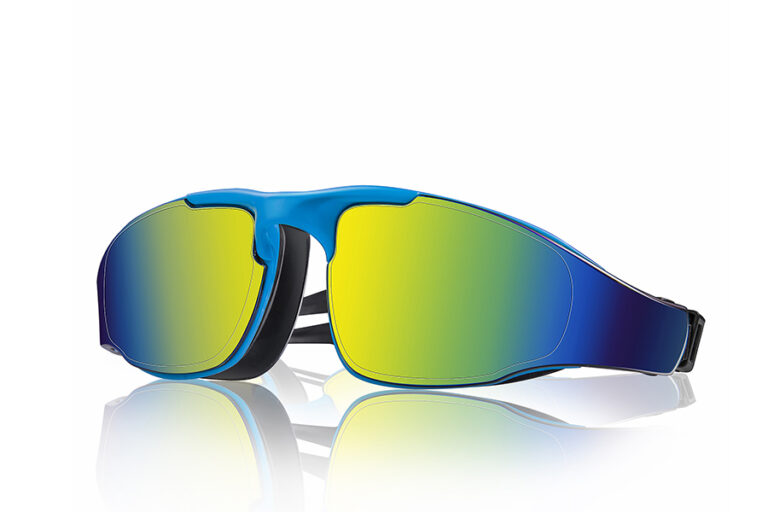
At Vanguard, co-injection anti fog goggles are the core of what we build: our patented molding process joins the liquid silicone and the lens assembly into one sealed optical unit inside the mold, with no adhesive boundary and no separately applied anti-fog layer. This article explains what that process is, what zero-leak actually means in test data, and what a patent-protected manufacturing route does for the brand that puts its name on the box. It is written for brand owners and retailers who are evaluating manufacturing partners, not for swimmers — we will stay on the engineering and commercial side of the question.
Points clés à retenir
- Fog and leak complaints usually share one root cause — a weak boundary between lens, cadre, and skirt. Co-injection removes that boundary instead of reinforcing it.
- In our production data, co-injection holds a leak-related return rate under 1%, against an industry average of 3–8% for glued assembly, with peel strength of 8–12 N/mm versus 2–4 N/mm.
- The process is patent-protected, which matters commercially: it lowers IP-infringement risk for your listings and supports defensible « integrated » claims on packaging.
- A co-injection program is fully specifiable — anti-fog grade, lens function, options dioptriques, and Pantone colors — with DFM feedback in 24–48 hours and prototypes in 15–30 days.
Why Fog and Leakage Are the Same Engineering Problem
Buyers tend to treat fog as an optical issue and leakage as a fit issue. On the production floor they are usually the same issue: a boundary somewhere in the goggle is failing. Conventional goggle assembly molds the frame, molds the skirt, coats the lens, and then joins everything with adhesive and mechanical clipping. Every one of those joints is a place where three things can go wrong at once:
- Adhesive outgassing near the lens. Solvent-based adhesives release volatile compounds as they cure and age. Those compounds condense on the inner lens surface and give fog a nucleation layer — the goggle fogs faster precisely because of how it was assembled.
- Bond-line inconsistency. Manual or semi-automatic adhesive application varies operator to operator and shift to shift. The unit that passes QC on Monday and the unit that leaks in March came from the same batch.
- Progressive degradation. UV, chlore, and temperature cycling attack adhesive chemistry season after season. A goggle that seals in month one can weep at the corner by month twelve — and the customer blames the brand, not the glue.
Co-injection takes the opposite starting point: if the boundary causes the failure, eliminate the boundary. That is the engineering logic behind our zero-leak claim — it is not a bolder promise than a glued goggle, it is a different architecture that removes the failure mode the promise is made about.
How the Co-Injection Process Builds a Goggle
The process runs in four controlled stages, each of which replaces a manual step in conventional assembly:
- Lens-substrate loading. The lens assembly is placed into a precision mold that holds it in exact position, with tolerances tightened to fractions of a millimeter. Because the fog-management function is engineered into the lens system at this stage rather than sprayed on a finished lens, there is no coated surface for a swimmer — or a production line — to damage.
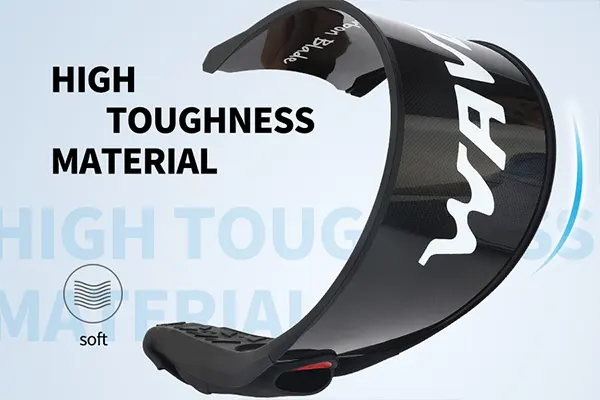
- Injection de silicone liquide. Caoutchouc de silicone liquide (LSR) is injected into the cavity surrounding the lens assembly and frame. The silicone flows into every channel and undercut designed into the part, forming a mechanical interlock at the micro level.
- In-mold curing and bonding. Heat cures the silicone while it cross-links with the treated frame surface, creating a molecular bond — not a layer of glue between two parts, but a single integrated component.
- Ejection and testing. The finished goggle section leaves the mold as one sealed unit and moves directly into performance testing: leak-tightness, pull force, and anti-fog duration are all measured in-house before any unit is cleared for assembly and packing.
The practical consequences for a buyer are consistency and traceability. Machine-controlled injection holds unit-to-unit variation within a few percent, where adhesive lines drift with every operator change. When your QA team pulls random samples from a 10,000-piece run, they are testing a process, not a shift.
What Does Co-Injection Change for Manufacturing Quality?
The table below summarizes the measured differences between co-injection and conventional glued-and-coated assembly, using the same metrics we report in first article inspection (FAI) and outgoing quality control (OCC) documentation:
| Quality Metric | Conventional (Glued + Coated) | Co-Injection (Integrated) |
|---|---|---|
| Skirt/frame peel strength | 2–4 N/mm | 8–12N/mm |
| Unit-to-unit variation | ±15–20% (application manuelle de la colle) | ±3–5% (injection commandée par machine) |
| Fog acceleration from assembly | Adhesive outgassing near lens | No adhesive near the lens path |
| Taux de retour lié aux fuites | 3–8% (moyenne du secteur) | Under 1% (based on our production data) |
| Service lifespan of the bond | Degrades with UV, chlore, temperature cycling | Molecular bond — no adhesive layer to degrade |
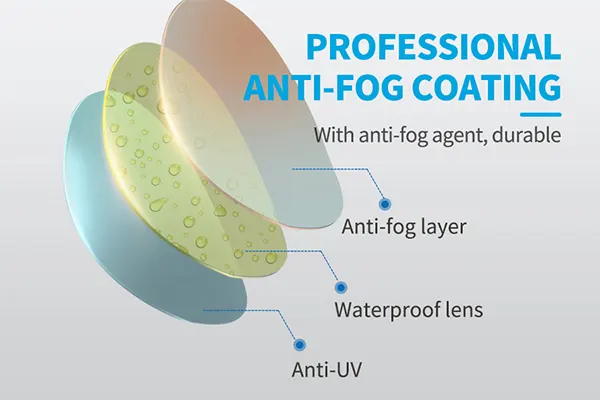
| Durabilité anti-buée | Coating wears with wiping and pool hours | Function engineered into the molded lens system |
| Tooling investment | Lower — separate molds, simple assembly line | Higher — precision integrated molds |
Two rows deserve a buyer’s attention. The return-rate line is the one your finance team feels: moving a goggle program from a 5% leak-and-fog return profile to under 1% changes the economics of the whole line. The variation line is the one your QA team feels: ±3–5% process spread means the golden sample your engineers approve and the last carton in the container behave the same way.
For readers who want the full technical walkthrough of how co-injection changed sealing performance in dive masks — peel test mechanics, cross-section evidence, and how to audit a factory’s co-injection claim — we published a dedicated deep dive on the silicone co-injection technology behind our mask lines. The process is the same platform described here for goggles.
What Does Patent Protection Mean for Your Brand?
Our co-injection process is patent-protected, and buyers usually underweight what that does for them commercially. Three effects matter:
- Lower infringement exposure on the shelf. Patent-holding manufacturers engineer around existing claims before tooling is cut, because we live with the patent landscape daily. Brands sourcing from anonymous assembly shops inherit whatever that shop copied — and platform takedowns and border seizures land on the brand name, not the factory.
- Defensible marketing claims. « Integrated silicone seal » et « molded-in anti-fog » are claims a patent-protected process can stand behind in writing. Claims borrowed from a supplier’s brochure often cannot survive a competitor’s challenge or a marketplace verification request.
- Design exclusivity is negotiable. On custom programs, mold ownership and exclusivity terms are on the table before tooling starts — protected under NDA protocols, with no mold fees on repeat orders of standard private label models.
Patent capability is also verifiable history, not just paperwork: the same development team behind our co-injection platform designed our panoramic full-face snorkeling mask, a product family we have exported globally under international design and utility protection. When a factory has taken its own products through that process, it understands what your IP counsel will ask for before your counsel asks it. This is part of a longer OEM track record that includes years of manufacturing for SPEEDO — a working relationship built on exactly the disciplines of confidentiality, cohérence, and schedule-keeping that goggle programs demand.
What Can You Specify on a Co-Injection Goggle Program?
A common misconception is that integrated molding limits design freedom. En pratique, the spec sheet for a co-injection program is as open as any OEM goggle program — the difference is which decisions get locked at the DFM (Conception pour la fabrication) stage instead of patched on the finishing line. Typical inputs we build to:
- Anti-fog performance grade. You specify the target fog-free duration and the acceptance test; we report measured results in the inspection package for every batch.
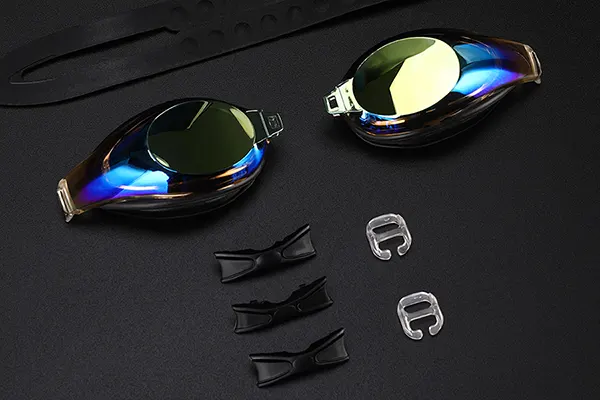
- Fonction de l'objectif. Polarisé, photochromique, mirrored REVO coating, and prescription diopter ranges are all available on the platform — including interchangeable nose-bridge sizing for fit programs.
- Materials and skin contact. Hypoallergenic LSR grades, with CE- and FDA-documented materials and OEKO-TEX Standard 100 coverage where your market expects it.
- Color and finish. Pantone references for silicone and frame, from monochrome private label runs to multi-color seasonal collections.
- Packaging and labeling. Private label artwork, barcode and compliance labeling, and retail-ready packing integrated into the same program.
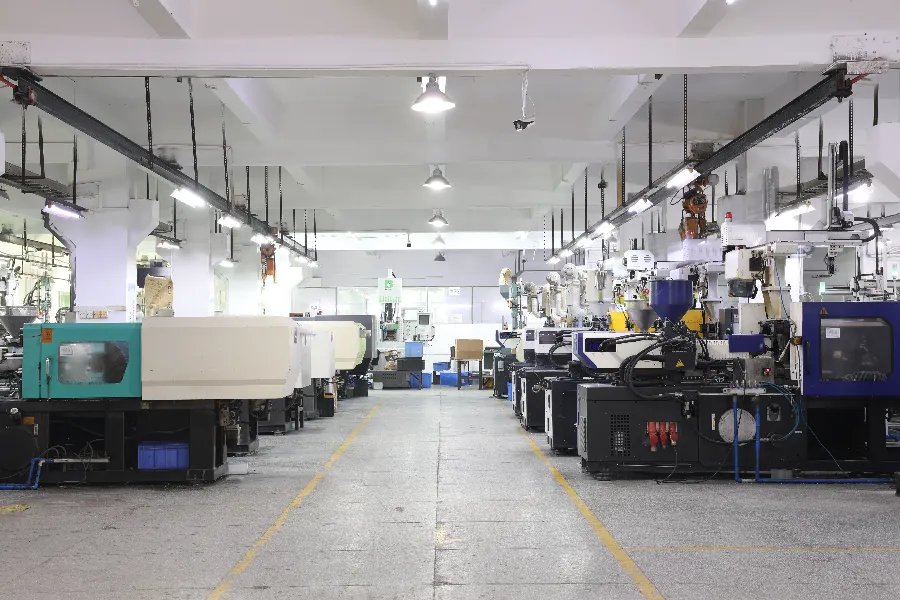
If you want to see how a full custom program runs from design files to shipment — mold development, golden samples, and the four-stage inspection sequence — our OEM customization process walkthrough covers it step by step, and readers curious about the factory floor itself can tour how swimming goggles are made in our production facility.
From Design Files to Container: the Realistic Timeline
Brand owners planning a launch calendar need dates, not slogans. For a custom co-injection goggle program, plan around these benchmarks:
| Scène | Typical Duration | What You Receive |
|---|---|---|
| DFM review of your design files | 24–48 heures | Mold feasibility feedback and engineering questions |
| Stock samples for evaluation | 2–7 days | Reference goggles to benchmark fit, finish, and anti-fog performance |
| Custom prototypes (y compris. outillage) | 15–30 jours | Your design, molded and testable |
| Production de masse (première commande) | 30–60 days after sample approval | FAI/OQC reports incl. durée anti-buée, leak and pull-force data |
| Repeat orders | Autour 30 jours | No mold fees on standard private label models |
For programs that need to test market demand before committing to tooling, stock models ship within 48 hours from our ready-to-ship inventory — a low-risk way to put co-injection performance in front of your customers while the custom molds are being cut. Program MOQs start from 300 pieces per color on goggle lines.
Foire aux questions
What does « zero-leak » actually mean — can any goggle guarantee it?
Zero-leak refers to the sealing architecture: co-injection produces a single integrated unit with no adhesive bond line, which is the component that ages and fails in conventional goggles. No honest manufacturer can promise a goggle will never leak when worn with the wrong strap tension or fit — what we guarantee is that the manufacturing boundary itself is not the failure point, and our leak-related return data stays under 1%.
How is co-injection anti-fog different from a spray coating?
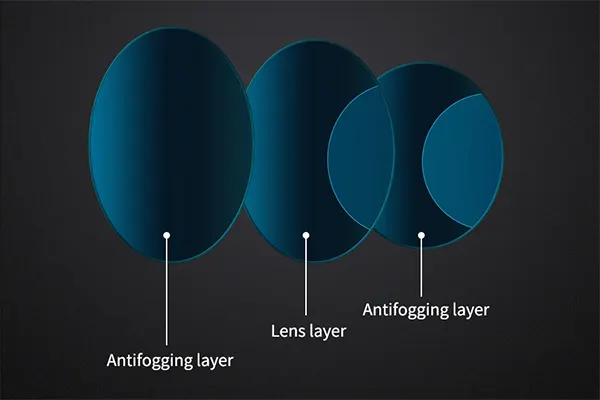
A spray coating is a consumable surface layer: it works when new and wears off with wiping, chlore, and time. In our co-injection platform the fog-management function is engineered into the molded lens system, so there is no separately applied layer to remove — and no adhesive near the lens whose outgassing accelerates fogging.
Can we get prescription and mirrored lens options on a co-injection program?
Oui. The platform supports diopter customization, polarized and photochromic lenses, and REVO mirrored finishes, along with Pantone color matching and interchangeable nose bridges. These options are locked at the DFM stage so the integrated molding accommodates them from the first tooling cut.
Does patent protection restrict what we can design or sell?
The opposite: it reduces your exposure. Sourcing from a patent-holding manufacturer means the process and geometry you build on were engineered with the patent landscape in mind, cutting the risk of infringement claims, takedowns, or customs holds landing on your brand. Custom designs are protected under NDA, and exclusivity terms are negotiable before tooling starts.
What is the minimum order for a co-injection goggle program?
Goggle programs start at 300 pièces par couleur. If you want to validate demand before committing to custom tooling, stock co-injection models are available from our ready-to-ship program with 48-hour dispatch. Send your target specification and we will confirm MOQ and pricing for your market.