Les retours des ailerons ne commencent pas par « la nageoire était mauvaise. » Ils commencent par « ça a pincé, » « mon talon a glissé, » « mon enfant en est sorti, » ou « pourquoi est-ce énorme? » Chacune de ces décisions est une décision de taille prise par quelqu'un en amont : un acheteur au détail commandant une courbe de taille., un vendeur Amazon choisissant la taille à tester, ou un chef de produit approuvant une forme de chausson. Obtenez la bonne taille d'architecture et la catégorie d'ailerons fonctionne toute seule; vous vous trompez et toute une saison de vente disparaît dans le traitement des retours.
La taille des palmes de plongée en apnée a sa propre logique qui fait que l'intuition empruntée à la pointure des chaussures ne cesse de se briser. Les poches pour les pieds sont moulées, dessus non souple - un demi-centimètre d'erreur se lit comme une douleur. Les modèles à pied complet sont disponibles dans des tailles discrètes avec presque aucune tolérance, les modèles réglables cachent une gamme à l’intérieur d’un SKU, et certains modèles à lame longue sont si grands que les acheteurs vérifiés conseillent de commander deux tailles en dessous. Un guide de dimensionnement pour un catalogue B2B doit couvrir les trois mécaniques à la fois: les bandes de taille elles-mêmes, la construction qui les porte, et les calculs d'assortiment qui les maintiennent rentables.
Ce guide définit les quatre bandes de tailles dont une gamme de palmes de plongée en apnée a besoin – enfants, jeunesse, adulte, et ajustement large : comment chacun correspond aux chaînes et aux groupes d'âge, quel effet la construction à pied intégral ou réglable a-t-elle sur votre courbe de taille, et comment construire un assortiment de première commande qui respecte le MOQ sans se noyer dans les stocks morts.
Points clés à retenir
- Une gamme de palmes de plongée en apnée fonctionnelle couvre quatre bandes de tailles – enfants, jeunesse, adulte, et coupe large – adaptée à la longueur du pied en centimètres, pas seulement pour vieillir, parce que les tranches d'âge se chevauchent et que les pieds ne mentent pas.
- Les poches sur tout le pied permettent une course de taille discrète; les bretelles réglables regroupent plusieurs tailles en un seul SKU. Le choix de construction est une décision de stock déguisée en décision de produit.
- Les retours axés sur l'ajustement se concentrent sur les tailles intermédiaires pour adultes de plein pied et sur les modèles à lame longue qui taillent grand - le conseil d'achat documenté pour une palme longue populaire est de réduire la taille de deux..
- L'aileron standard MOQ fonctionne environ 300 pièces par couleur - et MOQ s'empile généralement par SKU de taille de couleur, donc confirmer la base avec chaque fournisseur: une course de pied complet de cinq tailles peut atteindre 1,500 unités par coloris avant d'avoir vendu quoi que ce soit. Les SKU larges et pour enfants nécessitent un étui volumineux, ce n'est pas un cas d'exhaustivité.
- Publier des tableaux de longueur de pied en centimètres avec une dimension mesurée de la poche intérieure, et mets le modèle’Feuille de taille réelle sur la liste - les images de taille que votre usine peut fournir sont les filtres de retour les moins chers disponibles.
Pourquoi les tailles d'ailerons génèrent-elles plus de retours que tout autre SKU de sports nautiques?
Un masque mal ajusté peut être desserré. Un tuba ne convient pas du tout. Une palme est le seul élément de la catégorie que vous attachez à l'articulation la plus sollicitée du corps et que vous demandez ensuite à fléchir à plusieurs reprises pendant une heure.. Trois raisons structurelles font du dimensionnement le facteur de rendement dominant:
- Les poches pour les pieds sont rigides. Contrairement à une tige de chaussure, une poche en TPR ou en caoutchouc ne s'étire que légèrement. Une pochette moulée 4 mm en dessous de votre pied appuie les orteils contre la paroi avant pendant toute la séance; il n'y a pas d'effraction.
- L'eau change les calculs. Le montage se fait à sec, dans un magasin ou à partir d'une photo d'annonce; l'utilisation se fait humide, lorsque les pieds gonflent légèrement et que la prise pieds nus se comporte différemment. Des acheteurs qui correspondent « confortable mais bon » sec signale souvent une douleur après trente minutes humides.
- Le froid et les bottillons compriment la gamme. Un client envisageant de porter un 3 mm bootie a besoin d'une relation de taille fondamentalement différente de celle du même client pieds nus - et la plupart des annonces ne le mentionnent jamais.
La conséquence commerciale: dans une catégorie où une gamme de produits bien exécutée obtient une satisfaction moyenne de 4 étoiles, les plaintes concernant la taille sont ce qui fait baisser les annonces individuelles. Notre modèle à lame longue F-6876 est un exemple documenté : le consensus des évaluateurs est qu'il est suffisamment grand pour que les acheteurs devraient réduire la taille de deux tailles.. Ce n'est pas un défaut; c'est une caractéristique d'ajustement qui doit être indiquée sur l'annonce, dans le tableau des tailles, et dans la notice d'emballage, ou cela devient votre taux de retour.
De quelles quatre tailles de bandes un catalogue a-t-il réellement besoin?
Les définitions de bandes ci-dessous reflètent les pratiques courantes de l'industrie pour les palmes de plongée en apnée.; les coupures exactes appartiennent à votre usine’Feuille de taille s pour le moule spécifique, et Vanguard fournit des dessins de dimensions mesurées par modèle avec toute demande d'échantillon. Les quatre groupes méritent leur place car ils correspondent à des opportunités et à des canaux d'achat distincts..
| Bande de taille | Longueur typique du pied | Âge difficile / Porteur | Occasion d'achat | Poids du canal |
|---|---|---|---|---|
| Enfants | environ. 16–20cm | 3–6 ans | Sortie à la plage en famille; première vitesse; cadeaux | Boutiques de la station, grande distribution, forfaits familiaux |
| Jeunesse | environ. 20–23 cm | 6–12 ans | Programmes scolaires, excursions de plongée supervisées, remplacement de la croissance | Écoles de natation, voyagistes, commerce électronique |
| Adulte (S–XL) | environ. 23–29 cm | 12 ans et plus | Achat personnel; la bande par défaut | Toutes les chaînes; unités les plus profondes de cette bande |
| Coupe large | Longueurs adultes, dernier volume plus élevé | Pieds adultes larges ou hauts | Achat de solution après une mauvaise expérience d'ajustement | Commerce de détail spécialisé, e-commerce avec de bons filtres |
La répartition enfants/jeunes compte plus qu’il n’y paraît d’après les étiquettes de prix. Les données de marché sur les acheteurs de sports nautiques montrent systématiquement que les enfants constituent un véritable segment du public de la plongée en apnée plutôt qu'une réflexion après coup., et les voyages en famille achètent par ensembles – une paire adulte plus une ou deux petites paires par transaction. Des catalogues qui s'arrêtent à « petit = femmes » perdre complètement ce panier. Les âges de bande ci-dessus s'alignent sur les 3 à 6 / 6–12 / 12+ structurer la plupart des programmes de natation et de plongée avec tuba déjà utilisés, ce qui maintient votre étagère à ailettes compatible avec les masques, gilets, et des planches à côté - la même logique que notre Guide des tailles de masque de plongée intégral s'applique au côté masque du forfait familial.
Quel effet la construction a-t-elle sur votre courbe de taille?
La plus grande décision en matière de dimensionnement dans un programme d'ailerons n'est pas l'endroit où vous coupez les bandes, mais la construction qui les porte.. Les pieds pleins et réglables résolvent le même problème client avec des profils d'inventaire opposés.
Poches sur tout le pied: chaque taille a son propre SKU
Une palme chaussante s'ajuste comme une chaussure: tailles exactes, pas de reprise, tolérance minimale. C'est pourquoi une course complète sur tout le pied s'étend généralement sur cinq ou six tailles distinctes, des enfants aux adultes XL.. Chaque taille est son propre numéro de stock, son propre nombre de cartons, et son propre risque de stocks morts si la courbe est hors de la courbe. L’avantage est une précision d’ajustement et une expérience de vente au détail plus propre : des clients qui connaissent leur taille, connaître leur marque, et je veux le look d'un aileron monobloc.
Bretelles réglables: un SKU, une gamme de pieds
Les talons ouverts réglables absorbent deux ou trois tailles de pied complet dans un seul SKU réglable par sangle., travailler sur des bottines, et survivre à un enfant qui grandit pendant deux saisons. Les acheteurs de centres de villégiature et de locations les surpondèrent exactement pour cette raison. Le commerce est une dépendance matérielle – la sangle et la boucle deviennent le point de défaillance et l'objectif du contrôle qualité – et un ajustement légèrement moins raffiné pour le milieu de gamme.. Si votre chaîne est une chaîne de commerce électronique avec des acheteurs anonymes devinant les tailles sur un écran, les réglables réduisent la plus grande catégorie de « mauvais ajustement » retours.
Les catalogues les plus équilibrés présentent les deux constructions avec des courbes différentes: une gamme complète de tailles de pied complet pour la bande adulte volumineuse, et une course réglable compressée (souvent S/M et L/XL) couvrant l'utilisation des enfants jusqu'aux adultes et la location. Les quatre familles de conception à l'origine de ces constructions sont comparées dans notre guide des types de palmes de plongée en apnée, lame courte grâce à une sangle réglable.
Où Wide-Fit gagne-t-il son espace de stockage?
Les formes d'ailerons standard sont construites autour d'un pied de largeur moyenne, et deux populations réelles en sont exclues: adultes aux pieds larges, pour qui une poche de bonne longueur est douloureusement étroite sur le cou-de-pied, et les porteurs de bottines, pour qui la même poche est effectivement un short demi-taille. Les deux groupes résolvent actuellement mal le problème : commander longtemps et vivre avec un glissement du talon, ou abandonner l'achat.
Une bande large – les mêmes longueurs sur une forme plus volumineuse – répond aux deux. Il ne s'agit pas tant d'une nouvelle famille de moules dans la plupart des usines que d'une empreinte modifiée avec sa propre conversation d'outillage., alors traitez-le comme une extension de ligne planifiée avec un véritable MOQ derrière plutôt qu'une variante de couleur. L’analyse de rentabilisation est la plus solide là où les conseils adaptés sont rares: Les listes de commerce électronique avec une option claire et large et une explication honnête convertissent une supposition sujette au retour en une vente de solution, et les détaillants spécialisés l'utilisent pour compléter les raccords qui ont échoué lors du cycle standard. Si le volume annuel pour la courbe étalon justifie l'outillage, Wide-Fit se défend généralement sur la réduction de la marge et des rendements plutôt que sur le nombre d'unités brutes - modélisez-le avant de vous engager, et vérifiez la mécanique en gros dans notre guide de vente en gros de palmes de plongée en apnée pour savoir comment la taille des courses interagit avec le MOQ et le chargement des conteneurs.
Comment devriez-vous construire la courbe de taille de premier ordre?
Palme de plongée en apnée standard MOQ fonctionne environ 300 pièces par couleur, et la plupart des fournisseurs l'appliquent par SKU de taille de couleur - confirmez la base par écrit. De toute façon, l'arithmétique punit la complétude pour elle-même. Une séquence pratique qui a servi la plupart des premiers programmes:
- Commencer étroit, puis approfondissez. Testez une courbe compressée – enfants, jeunesse, adulte M, adulte L dans le coloris volume – avant de s’engager dans la course complète. Des échantillons de stock en 2 à 7 jours vous permettent de vérifier les formes; l'inventaire prêt à être expédié permet aux vendeurs en ligne de tester les ventes sans parier sur les outils.
- Pesez la bande adulte vers le milieu. Les tailles intermédiaires adultes portent les unités - et, être le plus proche de la falaise de tolérance d'ajustement, porte également les retours. Ces deux faits sont le même fait: spécifiez d'abord le tableau des tailles pour ces SKU, et mettez des indications de longueur de pied mesurée sur la liste avant la copie marketing.
- Laissez la construction absorber la queue. Les tailles enfants qui ont gagné’t réorganiser les pieds profonds et XL qui varient selon la population sont exactement là où les SKU à sangles réglables battent l'ajout de deux numéros de stock supplémentaires pour les pieds complets.
- Planifier la croissance comme un problème de taille. Avant qu'une deuxième saison ajoute un modèle, vérifier si la première saison’les données disent « plus de styles » ou « plus de tailles dans les styles vendus. » La réponse est souvent la dernière, et c'est moins cher.
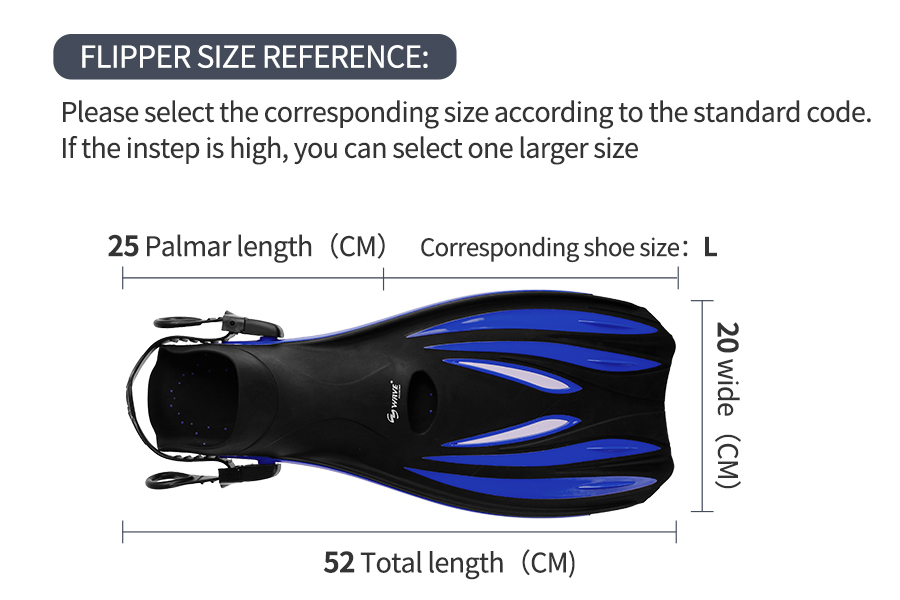
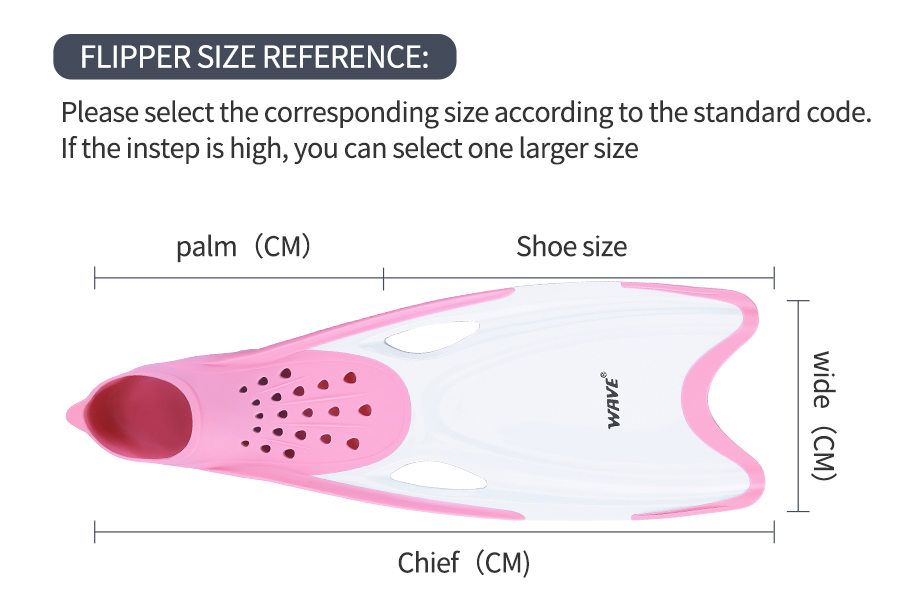
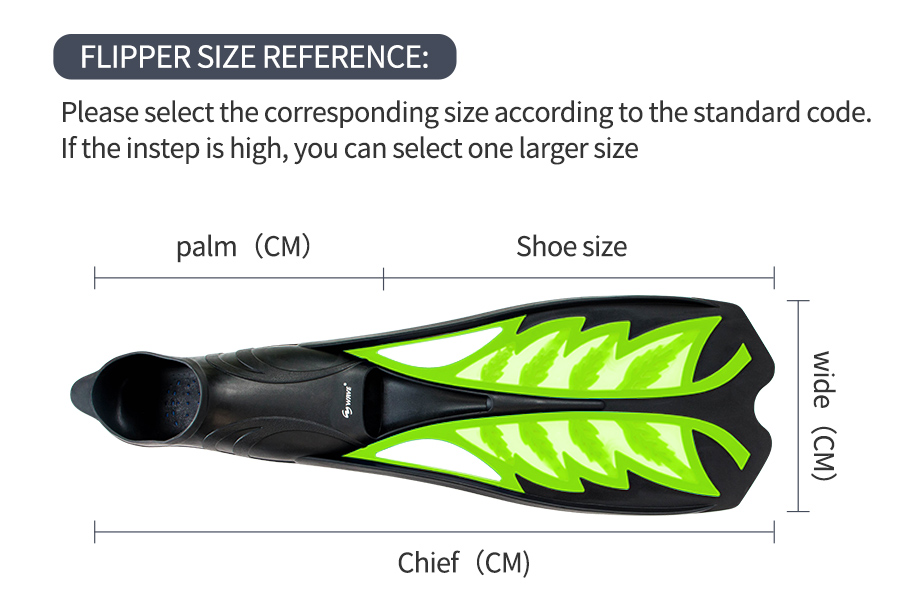
Une dernière discipline: conserver une langue de taille unique dans tout le catalogue. Si les masques fonctionnent en S/M/L, ailerons sur les numéros de l'UE, et vêtements par tranche d'âge, le forfait familial qui devrait augmenter la taille du panier devient une question de compatibilité que les clients ne tenteront pas. Les tableaux de tailles fournis par les usines par modèle - comme la référence adulte F-6860 ci-dessous - constituent la matière première d'un tableau cohérent pour toutes vos annonces..
Foire aux questions
Les listes de palmes devraient-elles indiquer les pointures ou la longueur du pied en centimètres?
Les centimètres d'abord, conversion de pointure seconde et visiblement approximative. Les formes des chaussons ne suivent aucune marque de chaussures’dimensions intérieures, et tables de conversion à travers les États-Unis, ROYAUME-UNI, et les systèmes de l’UE invitent à l’inadéquation exacte qui génère les rendements. Le modèle fiable est: instructions pour mesurer votre pied, une table de bandes basée sur les cm, le modèle’Image de feuille de taille propre, et équivalents de chaussures clairement étiquetés à titre indicatif.
Pourquoi certains modèles d'ailerons demandent-ils aux acheteurs de réduire leur taille?
Les formes à lame longue et orientées vers l'apnée sont souvent moulées avec un volume supplémentaire au niveau des orteils pour une utilisation avec des chaussons ou pour garder le pied droit dans une poche rigide., donc le même pied qui prend la taille M dans une palme de voyage peut avoir besoin d'un S dans ce modèle. C'est une caractéristique par moule, ce n'est pas une règle de marque - c'est exactement pourquoi le conseil doit figurer sur la liste avec le modèle’feuille de taille s, comme les acheteurs vérifiés de l’un de nos modèles à lame longue ont appris à le faire, recommander deux tailles en dessous.
De combien de tailles une première commande de palmes de snorkeling a-t-elle réellement besoin?
Moins que ce que dit l'instinct. Si le MOQ s'applique par SKU de couleur et de taille, aux ~ 300 pièces habituelles pour les ailerons, une course de pied complet de six tailles en deux couleurs est 3,600 unités avant une seule vente. Une ouverture plus forte est une courbe compressée – deux tailles enfants/jeunes, adultes M et L – plus un S/M et L/XL réglables qui comblent les espaces, puis en élargissant la série au cours de la deuxième saison à partir des ventes démontrées.
Un stock de palmes de plongée en apnée larges vaut-il la peine d'être transporté en tant que détaillant?
En règle générale, seulement là où vous pouvez y joindre des conseils. Wide-fit se vend comme une solution d'achat - aux clients arrivant après un ajustement standard douloureux, ou des porteurs de bottines qui ont été à la hauteur et qui ont encore mal. Dans un rayon de vente au détail en libre-service, cette histoire n'atteint jamais l'acheteur et le SKU vieillit; dans le commerce spécialisé ou une référencement e-commerce avec une visibilité claire « quelle coupe est la votre » explicateur, il se convertit à des taux élevés et rapporte mal.
Une usine peut-elle changer un aileron existant’gamme de tailles?
Oui, dans les limites. L'ajout de tailles à l'intérieur d'une dernière famille existante est généralement une modification d'empreinte ou d'insert — un projet d'outillage mesuré en semaines, pas un nouveau programme de moulage. Déplacer toute la gamme (dire, ajout d'une forme junior véritablement étroite) modifie l'ensemble de cavités et devrait commencer par la révision du DFM, ce qui prend 24 à 48 heures pour répondre à la faisabilité et au coût avant de valider des échantillons. Demandez le moule actuel’dessin de taille s en premier; la réponse la moins chère est souvent qu'une cavité couvre déjà la taille dont vous pensiez avoir besoin.