A freediving fin shelf that looks well-rounded on a catalog page can quietly strand a retailer in dead stock, and the culprit is usually the heel configuration rather than the blade. Closed-heel (full foot) fins and open-heel fins solve the same job — moving a diver through water with minimal effort — but they behave very differently once sizing, مُكَمِّلات, معدلات العودة, and reorder cadence enter the purchasing model. A retailer who treats them as one interchangeable line will over-order the wrong one and under-serve the customer who was ready to buy.
This guide is written for the buying decision, not the swimming decision: what each heel type actually demands from a sizing program, how it changes your return and accessory economics, what the tooling and MOQ differences look like from a factory, and how to structure a two-configuration assortment that turns instead of stagnates.
الوجبات الرئيسية
- Closed-heel (full foot) freediving fins sell shoe-style sizes and cannot be shared across a diver’s booties — the sizing burden moves onto you, the retailer, and so does the return rate when the fit is wrong.
- Open-heel fins pair with a 5mm bootie and an adjustable strap, which absorbs most fit variance and lets one SKU cover a wider foot range — fewer size splits, lower return traffic.
- From a factory standpoint, a full foot pocket is a single molded last; an open-heel frame plus strap is a different tool family. Do not assume a supplier’s closed-heel molds give you open-heel options at the same MOQ.
- Open-heel programs monetize the bootie and strap as attach-rate; closed-heel programs rarely do. That difference is worth modeling before you commit shelf space.
- The mature assortment is not one-or-the-other: carry open-heel as the volume workhorse and closed-heel as the travel and warm-water niche, both on proven tooling.
What do “كعب مغلق” و “open heel” actually describe?
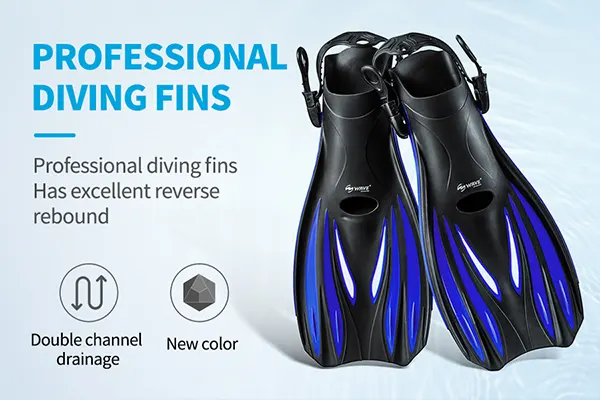
The terms refer to the foot pocket, ليس النصل. A closed-heel fin is a full-foot pocket that slips on like a slipper — the diver’s bare foot or a thin sock goes directly in, and the pocket itself provides the seal and the retention. An open-heel fin leaves the heel exposed; the foot sits in a partial pocket and is held by a heel strap, worn over a neoprene bootie. That single mechanical difference ripples through sizing, accessory pull-through, fit tolerance, و, on the supply side, الأدوات.
لمتاجر التجزئة, the practical distinction is where fit responsibility lands. With closed heel freediving fins, the foot pocket must match the foot closely, so the retailer carries the size curve and eats the returns when a customer guesses wrong. With open-heel fins, the adjustable strap plus a bootie does the fitting work, so a narrower SKU count covers a broader range of feet. Neither is “أحسن” in the water — the question is which fit model your channel can actually support.
How does sizing and return economics change between the two?
This is where the two configurations diverge most sharply on a purchase order.
Closed heel: shoe-size granularity
Full-foot fins are sized like footwear, usually in whole and half sizes, and the fit window is genuinely tight — a pocket that is a half size off either crushes the foot or lets the fin slip and blister. That means a credible closed-heel shelf is eight to twelve individual size runs per colorway. Miss-size returns are the dominant failure mode: the customer cannot try a full-foot fin on properly without getting it wet, so a meaningful share of online closed-heel sales come back as fit failures.
فتح كله: strap-tolerant range
Open-heel fins are sized more coarsely — often S/M/L — because the strap and the bootie together absorb a couple of shoe sizes of variance. A diver wears a 5mm bootie, and the strap is dialed to their foot. The result is fewer SKUs to stock, less return pressure, and a fit conversation that centers on the bootie rather than the fin. For a distributor without a strong returns infrastructure, that tolerance is a real operating advantage.
The sizing logic that separates the two is worth handing to your accounts directly; ال دليل مقاسات زعانف الغطس breaks down the kids/youth/adult bands and how they interact with heel type, so buyers do not confuse a full-foot size chart with an adjustable one.
What do the heel types mean for tooling and MOQ?
A full-foot pocket is molded as one continuous last around the foot shape; the mold has to produce the internal cavity and the sealing skirt in a single piece. An open-heel design is a different family — a foot cradle plus a separate strap assembly, frequently with a stainless pivot and a quick-release buckle. A factory that runs closed-heel molds has not automatically given you open-heel capability at the same minimum order, because the tooling and the strap hardware are distinct line items.
For sourcing, that means you should confirm, per supplier, three things: which heel configurations their existing molds already cover, what the per-colorway MOQ looks like on each (a common baseline in this category is around 300 pieces per color on shared tooling), and what a new tool for the configuration you lack would cost in both money and the 15-30 day prototyping window before mass production. A supplier with in-house mold development can quote that path concretely; a trader cannot. The manufacturing-technology angle is covered in the carbon freediving fins sourcing guide, and where you are considering a private-label heel configuration on your own last, ال صفحة التصنيع المخصصة explains how tooling and DFM (تصميم للتصنيع) feedback work.
Which heel configuration fits which buyer and channel?
Heel type maps to customer profile more cleanly than most retailers model it. Getting that mapping right is the difference between a fin line that turns and one that becomes end-of-season clearance.
| البعد | Closed heel (full foot) | فتح كله + حزام |
|---|---|---|
| Sizing SKU load | High — 8-12 footwear sizes | Low — S/M/L, strap absorbs variance |
| Fit failure / returns | أعلى, especially online | أدنى, bootie-assisted |
| Bootie requirement | None for warm water | Yes — attach-rate opportunity |
| Typical buyer | يسافر, ملجأ, warm-water snorkel-to-dive | Cold-water, spearo, trained freedivers |
| Blade pairing | Shorter/medium, plastic or rubber | أطول, often carbon or glass |
| Channel fit | Resort rental, gift, e-commerce impulse | Dive shop, specialty, برامج النادي |
Read as a channel map, the pattern is consistent: closed-heel fins win in warm-water and travel contexts where the diver wants to skip the bootie and grab a compact pair for a resort trip, while open-heel fins own the cold-water and serious-training shelf where a bootie is non-negotiable and a longer carbon blade is expected. A resort and travel retailer can lean on closed-heel almost entirely; a dive shop leaning toward training and spearfishing overlap should lead with open-heel. For the broader configuration landscape — short blade, ينقسم, تمرين, and long freediving fins — see the types of snorkeling fins guide.
How does material interact with the heel choice?
Heel configuration and blade/foot-pocket material are decided together, because the pocket has to bond to the blade and survive repeated flex. Thermoplastic rubber and silicone blends dominate full-foot pockets for their soft seal against bare skin; open-heel frames are frequently a stiffer polymer that carries a longer, higher-resilience blade. The same material logic that governs the blade governs how the pocket ages — a cheap rubber pocket cracks at the seal line, and that becomes a warranty claim regardless of heel type. ال fins materials guide covers rubber, نظام الحماية المؤقت, السيليكون, and composite behavior in detail, and it is the reference to keep beside your heel-type decision rather than treating them as separate questions.
How should a retailer build a two-configuration program?
Carrying both heel types is not doubling your risk — it is segmenting it, provided you build the program in the right order.
- Lead with open-heel as the workhorse. Lower SKU count, strap-tolerant fit, and a bootie attach-rate make it the safer first commitment. Weight your opening depth here.
- Add closed-heel as a warm-water and travel niche. Stock it shallow and in the two or three fastest-moving sizes only after you see demand signals, because the size curve is where it will strand you.
- Keep both on shared, proven tooling. Bespoke molds on either configuration restart the tooling clock; a supplier with existing freediving-fin molds lets you reorder on the fast path. Where you want your own branding on a shared last, ال custom snorkeling fins OEM guide walks through logo, لون الشفرة, and heel-type options.
- Tie heel type to blade length deliberately. Do not offer a full-foot pocket on a long carbon blade and expect it to fit the same diver who wants an open-heel training fin — the two configurations serve different divers, and cross-listing them confuses the shelf.
Explore the fin range and configuration options against your current assortment on the freediving fins category page, and use it as the anchor when you compare what each supplier can actually ship on which tooling.
الأسئلة المتداولة
Should a first freediving fin order be all closed-heel or all open-heel?
Open-heel first for most channels. The adjustable strap plus bootie means fewer individual SKUs, lower fit-failure returns, and a natural attach-rate on booties. Add closed-heel as a warm-water and travel niche once you can see which sizes actually move, because a full-foot size curve is where a first order is most likely to strand inventory.
Do closed-heel and open-heel fins share the same MOQ from a factory?
Not automatically. A full-foot pocket and an open-heel frame with strap hardware are different tool families, so a supplier’s existing molds may cover one configuration far better than the other. Confirm per model which heel types sit on shared tooling and what a new tool costs and adds to the 15-30 day prototyping window before you assume the minimums are equal.
Which heel type has a higher return rate for online sales?
Closed-heel (full foot), consistently. A customer cannot properly judge a full-foot fit without getting wet, so half-size and volume mismatches come back as returns. Open-heel fins let the strap and bootie absorb fit variance, which is why they tend to carry lower return traffic in e-commerce and in channels without a strong fitting service.
Can I sell the same blade in both a closed-heel and an open-heel version?
أحيانا, but treat it as two products. A short or medium blade suited to a bare-foot full pocket is not the same fit as a long blade on an open-heel frame worn over a bootie, and the foot-pocket-to-blade bonding differs. Decide the heel configuration and blade length together, matched to the diver you are serving, rather than assuming one blade can be dropped into both pockets for the whole shelf.