A dive school buys freediving fins the way a fleet manager buys anything: not one perfect pair, but twenty pairs that survive five seasons of beginners, fit feet from 36 к 45, and still feel like a premium course product on the day the instructor hands them out. The retail logic — best blade, prettiest colorway, highest margin — quietly falls apart at course scale, because schools are optimizing for durability per session, size coverage, replenishment speed, and a price the program can carry year after year.
This guide walks through how a school fleet spec should differ from a retail shelf spec, how MOQ and bulk program economics actually work on a factory order, and how instructor discount and program pricing structures are typically negotiated — so you know what to ask for before you ask.
Ключевые выводы
- School fleets are sized by coverage, not by shelf appeal: one or two colorways spread across a complete size curve beats five colors with gaps — and gaps are what break a factory MOQ.
- Stiffness should map to course level: forgiving medium blades for beginner courses, a small pool of stiffer blades for advanced and instructor use, decided the same way retailers plan a range (see our stiffness grades guide).
- Durability features — rail protection, strap and buckle serviceability, sole wear — are the real cost-per-session levers; a cheaper fin that dies in year one is the most expensive thing in the locker.
- Discount structures for schools generally come in four shapes: volume tier pricing, an annual program agreement, a demo/loaner unit allowance, and an instructor pre-order channel. None of them are automatic — they are negotiated and should be written into the quote.
- Plan orders around documented factory cadence: образцы товара за 2–7 дней, first production 30–60 days, reorders on proven specs around 30 days — which means pre-season ordering is a calendar decision, not a last-minute one.
Why school fleets need a different fin spec than retail shelves
A retailer sells a fin to someone who chose it. A school hands the same fin to a hundred people who did not — beginners with no kick technique, travel students in borrowed booties, instructors using the demo fleet every single day. Three consequences follow, and they change every spec decision downstream.
Первый, fit tolerance becomes the top constraint. Marketplace review history on long blades consistently flags sizing as the friction point — freediving fins frequently run generous, and students sized like their shoes end up swimming in flip-flops. A fleet that absorbs this error, whether through a tightened size curve, open-heel straps, or a documented «size down» fitting rule, generates fewer mid-course swaps and fewer blown sessions. Второй, the damage profile is different: training use means deck drops, rocky entries, fins borrowed and returned wet and unsalted, so serviceability beats weight. Третий, replenishment has to be boring: the school that cannot reorder the same blade in March has effectively bought a one-season product. That is why the fleet decision should be made as a program — model, size curve, материалы, and reorder cadence locked in writing — not as a series of one-off purchase orders.
How should a school size its stiffness and skill tiers?
Freediving fins are not one product; they are a performance band, and courses move students along it. The mistake is buying a single tier for the whole school.
Beginner and Level 1 курсы: forgiving and durable
New freedivers do not generate the leg load that stiff blades need to come alive; a hard blade on a first-course student is effort without propulsion. Medium to soft blades in polymer or rubber-blend construction fit this tier — they are also the cheapest to replace in volume. The physics of why softer blades suit weaker kicks, and how the grades sell differently, is worked through in our freediving fins stiffness grades guide.
Advanced courses and depth training: the stiffer pool
As technique and strength develop, students progress onto stiffer, longer blades — glass fiber and, for the small number who will pay for them, углерод. This tier should be a minority of the fleet: strong demand exists, but it belongs to a few advanced workshops per season, and the units double as instructor demo gear.
Instructor and demo use: reliability over specifications
Instructors hammer the demo fleet daily, so this tier is bought on durability and serviceability — interchangeable blades matter here more than anywhere else in the locker, because one pocket platform can carry multiple blade conditions.
A sensible first fleet often lands near a 70/20/10 split across beginner, progression, and advanced tiers, adjusted for whether the school is a beginner factory or a technical-training center. What matters is that the tiers exist as a documented spec, so the next order restocks the same mix instead of improvising.
Which durability specs lower cost per session?
Schools should price fins in sessions, not in units. Four spec lines move that number.
Material honesty
Polymer blades are the volume workhorse; glass fiber buys a livelier kick at mid-tier cost; carbon buys the best power-to-weight but hates point impacts — a carbon blade leaning on a boat ladder is a cracked blade. The material-by-material trade-off, including how to verify supplier claims, is covered in the freediving fins blade materials comparison.
Рельсы, советы, and soles
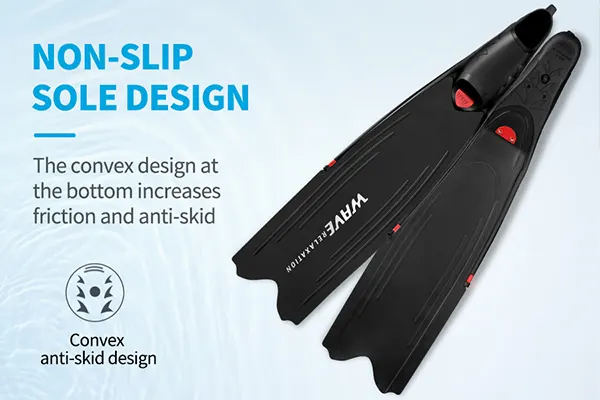
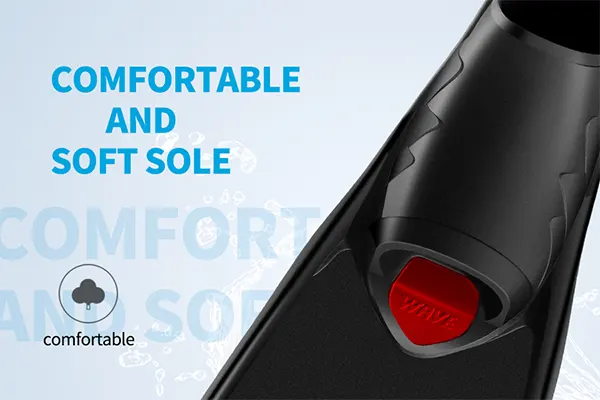
Ask specifically about reinforced rails and tip protection on school configurations — the two surfaces that die first from dragging and stacking — and check sole thickness for walking. These are mold-level features, which means they live or die with the model you choose, not with any add-on you can request later.
Straps and buckles as consumables
On open-heel configurations, the strap system fails more often than the blade. Pin down whether buckles and straps are replaceable, whether spare hardware ships with the fleet order, and how quickly replacements can be reordered. Heel-style economics for rental and school use — sizing tolerance versus breakage — are analyzed in our closed-heel vs open-heel freediving fins гид.
Identifiability
Understated but real: a fleet needs to be countable. A single school color, or a subtle printed marking on the blade, turns «we lost three fins this season» into an inventory fact instead of a rumor. Logo printing on existing tooling is a low-cost customization — it does not require new molds, only artwork and a per-color volume commitment.
What does a bulk fin program actually look like with a factory?
Here the arithmetic gets concrete. Factory customization baselines are set per color, не за заказ: for masks, сноркели, и плавники, the documented starting point at Vanguard is around 300 штук каждого цвета. For a school, that number is the whole game — because a fleet needs a size curve, and a size curve splits one order into many line items.
How to make the math close
The standard move is to compress the color plan and expand within sizes: one or two colorways, weighted to real foot distribution (size 38–43 will hold most of the fleet; extremes are thin), so the total of one colorway clears the per-color baseline. A school ordering six sizes across three colors needs 1,800+ units to hit the same baseline; the same school ordering twelve sizes in one color needs 300. Same students, radically different invoice.
Cadence and calendar
Documented working timelines: stock samples in 2–7 days for evaluating fit and build, first mass production runs at 30–60 days, reorders on proven specifications typically compressing toward 30 дни. For a school, that translates into one hard rule — pre-season is ordered in-season. Fleet orders land right after peak summer, to be in the locker before winter courses; reorders mid-season work only against stock, which is exactly the case for keeping a running agreement with a supplier who holds semi-finished inventory (our ready-to-ship line exists for precisely this kind of fast top-up, with stock dispatch quoted at 48 часы).
Paperwork schools actually need
Insurance, federations, and parent-facing compliance ask for documents, не обещает. Certification coverage (CE, FDA, Стандарт ОЭКО-ТЕКС 100 on materials, under an ISO 9001:2015 and BSCI-audited operation) plus inspection reports on the delivered batch — with the test data behind seal, растяжимый, and fog performance where relevant — should arrive with the shipment. Ask for the document list before the first order, not after the first incident.

How are instructor discounts and program pricing usually structured?
A candid note first: school and instructor pricing is negotiated per program, not published — no responsible buyer should treat any discount figure in this article as a supplier’s standing offer. What can be described honestly is the shape of these deals, because knowing the four standard structures is what turns «do you give discounts?» into a real conversation.
Volume tier pricing
The baseline: unit price steps down at order bands. What matters for schools is that tiers are defined on the fleet program’s annual total, not each individual purchase order — otherwise every top-up order reprices at the entry tier. Ask for the tier table against your projected year in writing.
The annual program agreement
A step up from tiers: one committed seasonal volume, one locked spec, one price, with scheduled reorders drawn against it. This is how schools buy the boring way — predictably and cheaply — and it is also the structure that protects the school from a supplier quietly changing a blade compound mid-year.
Demo and loaner allowance
Common in instructor networks: a handful of units at program cost (or included) for the demo fleet and coach use, sized against the committed volume. Small in dollars, large in credibility — instructors who swim on your fleet sell your courses.
Instructor pre-order channels
The classic «instructor discount»: certified staff order personal gear at program pricing outside the fleet PO. The negotiation points are eligibility (which certifications count), annual unit caps, and whether pre-orders ship on stock timing. Schools running multi-location networks often roll these into the annual agreement so instructor pricing is a policy, not a favor.
| Структура | What you commit | What to pin down in writing |
|---|---|---|
| Volume tiers | Order size bands | Tiers measured on annual total, not per PO |
| Annual program | Seasonal volume + locked spec | Spec-change notification, reorder pricing, delivery windows |
| Demo allowance | Program participation | Unit count, refresh cycle, damage liability |
| Instructor pre-order | Certification roster | Eligibility rules, unit caps, shipping timing |
One more lever worth knowing: standard private-label models carry no mold fees on repeat orders, and molds and designs stay under NDA — which means a school that develops its own marked fleet configuration is not accidentally buying a tooling liability on reorder number two.
Часто задаваемые вопросы
How many freediving fins does a dive school need for a bulk order?
Customized fleet configurations are planned around the factory baseline of roughly 300 штук каждого цвета. A school that keeps to one or two colorways and spends the volume across a full size curve reaches that with a realistic fleet; splitting into many colors multiplies it. Smaller starter orders are usually served from existing stock configurations instead of customized runs.
Should a beginner course use soft or stiff freediving fins?
Medium-to-soft blades in durable polymer are the standard beginner-course choice: they load with less leg strength, forgive poor kick technique, and cost least to replace. Stiffer glass and carbon blades belong in the advanced tier and instructor demo pool, where swimmers can actually drive them.
Can schools get fins in assorted sizes under one order?
Yes — and they should insist on it. Per-color MOQ is a total across the size curve, not a per-size minimum, so the practical move is one colorway, twelve sizes, weighted toward the common range. Agree the size distribution in writing on the first order so reorders repeat the same curve instead of renegotiating it.
When should a school place pre-season fin orders?
Count backwards from your course calendar: samples take 2–7 days for existing configurations, and first production runs 30–60 days, with reorders on proven specs closer to 30. A school starting its spring season should have the fleet order placed by late winter at the latest — and an annual program agreement removes the scramble entirely.
Are carbon fins worth it for a school fleet?
Usually not as fleet units. Carbon’s advantage — stiff, light, fast recoil — is wasted on beginners and vulnerable to deck abuse, at several times the replacement cost of polymer. The rational school pattern is polymer volume, a few glass-fiber progression blades, and a small carbon set reserved for instructor demo and advanced workshops.