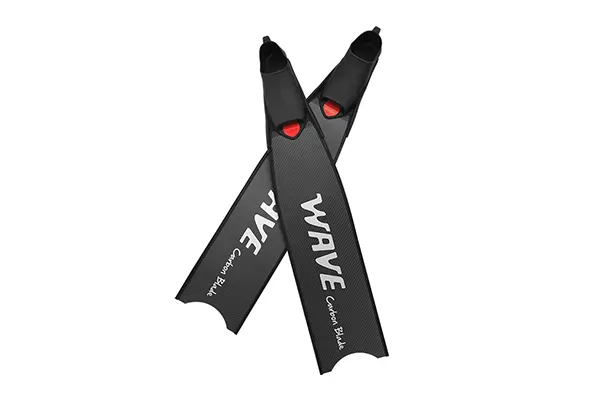
A custom freediving fin program looks simple on a mood board: your logo on a long, elegant blade, in your brand colors, priced like the premium end of the shelf. Then the supplier conversation starts, and the questions pile up fast. Which parts of a fin can actually be changed at a realistic order volume? Does a «custom blade angle» need a new mold, or is that marketing talk? How much does your foot pocket choice really control return rates? And what does any of it add to the cost per pair?
This guide breaks custom freediving fins OEM work into the four decisions that move money — blade geometry, карман для ног, graphics, and tooling level — and shows what each one costs you in MOQ, Время выполнения, and risk, so you can spec a program that a real factory can deliver on a real schedule.
Ключевые выводы
- «Обычай» is a ladder, not a switch: logo printing and color changes run on existing molds at modest volumes; a new foot pocket or blade geometry is a tooling project with a different budget and timeline entirely.
- Most brands get 80% of their differentiation from the cheap rungs — blade color, pocket color, распечатать, and packaging — and leave the expensive rung (new molds) for a platform product they intend to sell for years.
- Карман для ног, не лезвие, drives fit complaints and returns; sizing curve, bootie compatibility, and heel style are the highest-leverage custom decisions for sell-through.
- Ask any serious factory for Design for Manufacturing (ДФМ) feedback before you fall in love with a render — a good partner tells you within days which geometry will not mold cleanly, and what it will cost to fix.
- Baseline customization on established tooling typically starts around 300 pcs per color for fin categories; full new-mold programs are planned around first-article samples and longer lead times.
Что значит «обычай» actually mean on a freediving fin?
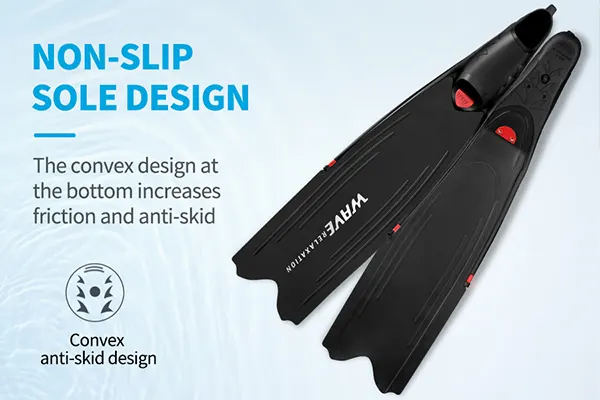
A long-blade freediving fin is three engineered parts plus finishing: the blade, the foot pocket, и (on open-heel models) the strap and buckles. Almost every customization request lands on one of those four things, and each has its own cost logic.
Level 1 — Graphics on existing tooling
Logo print, product color selection, and packaging are the entry rung. You take an established mold platform — a blade and pocket that already runs clean in production — and apply your brand. Order sizes can stay modest because nothing new needs to be cut; at Vanguard, the working baseline for fin-category customization is around 300 штук каждого цвета, and stock samples of existing models ship in 2–7 days so you can evaluate print quality before committing.
Level 2 — Color and material specification
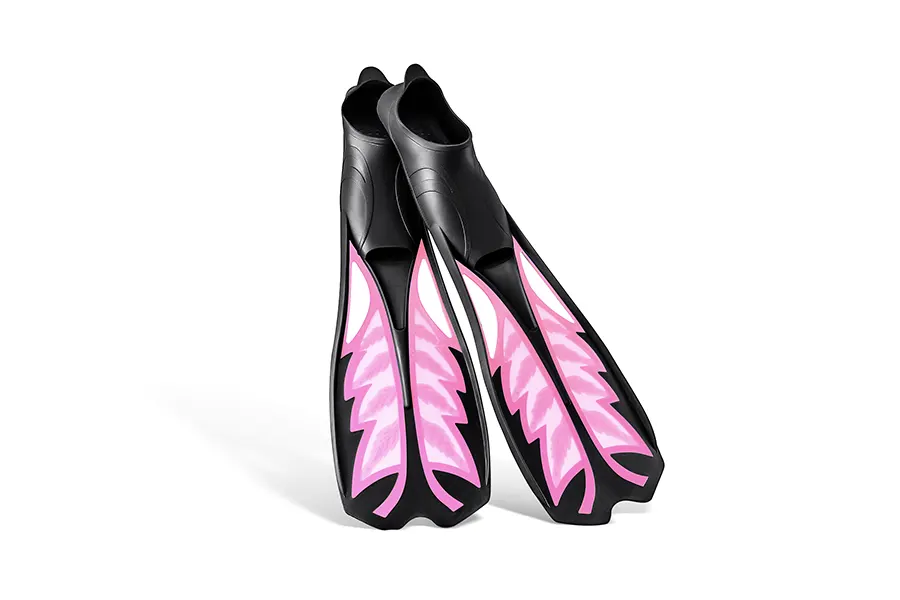
The next rung changes what comes out of the mold, not the mold itself: translucent or opaque blades, a different polymer grade, a softer or stiffer compound, glass fiber in place of plain plastic. This is where a shelf-ready «brand palette» gets built — same tooling, visibly different product.
Level 3 — Component mixing
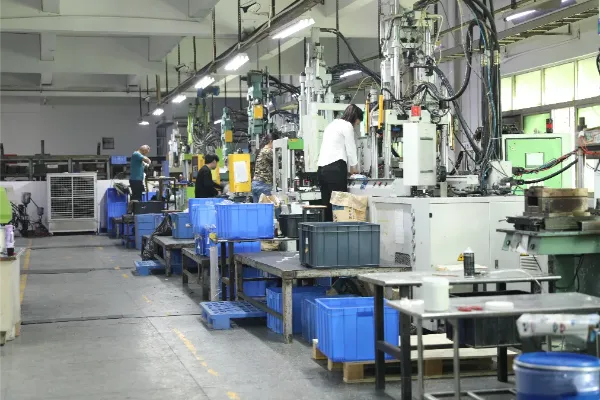
Interchangeable-blade systems deserve their own line, because they turn customization into a platform decision. A single foot pocket tooling combined with soft, середина, and stiff blade options lets one mold serve beginner, развлекательный, and trained divers. Our factory runs in-house CNC mold development, four production lines, и 65 машины для литья под давлением, so recombining existing pockets with existing or modified blades is routine work rather than a special project.
Level 4 — New geometry, new mold
When you want a blade contour, rail profile, or pocket volume that does not exist yet, you are commissioning tooling. That is the rung where DFM conversation, образец утверждения, and lead time all step up — and where your design needs to be worth protecting, because it is also the rung competitors cannot copy from your catalog page.
Which blade parameters can you customize — and which matter?
Blade specs are where brand decks get most romantic, so it pays to separate the parameters that change swimming feel from the ones that only change the invoice.
Length and planform
Long blades are the category’s signature — the leverage and energy storage that make a freediving fin so efficient are covered in our guide to what makes freediving fins so long. Changing blade length or outline means new tooling, so treat it as a platform decision: pick a length that matches the customer you actually sell to, not the one in the demo video.
Stiffness and taper
Stiffness is the parameter customers feel first, and it comes from material, толщина, and taper together. For most branded programs, the smart route is not inventing a new flex — it is selecting across an existing soft/medium/hard band and building your range on it. The merchandising logic behind that band is worked through in our freediving fins stiffness grades guide; if you are specifying carbon, verify the layup claims before you price them, using the checks in our carbon fiber freediving fins sourcing guide.
Blade angle and rail geometry
«Blade angle» in a spec sheet usually describes two things: the offset between blade and pocket axis, and the sweep of the tip. Both shape how the fin loads through the kick cycle. They are genuinely customizable — and genuinely mold-level work. Прежде чем совершить, send the geometry to the factory and ask for DFM feedback: Vanguard’s engineering team turns around mold-feasibility comments within 24–48 hours, which is the cheapest insurance in the whole program. A blade that will not fill cleanly in injection or laminate flat in a press is not a design tweak away from production; it is a redesign.
Interchangeable systems
If your program targets multiple skill levels, an interchangeable blade locking system lets you sell one pocket with three or four blade options. Tooling gets more complex — the lock is precision work — but the SKU economics afterward are much better than running three parallel full fins.
Why the foot pocket decides your return rate
Blades sell the product; pockets generate the returns. Fit is the complaint that ends up in your review section, and it is almost entirely engineered at the pocket.
Size curve
Before any styling conversation, pin down the sizing ladder you are buying: which EU/US sizes exist per color, and where the gaps are. A custom colorway in the wrong size curve is dead stock with your logo on it. Sizing strategy for heel styles and width variation is covered in depth in our closed-heel vs open-heel freediving fins buying guide.
Объем, bootie compatibility, and heel style
Freediving pockets run bare-foot or bootie-specific, closed or open heel, with meaningful differences in internal volume. Each is a mold-level decision. The sole gets custom attention too — thickness, texture for deck walking, and drainage all come out of the same tool.
What tooling a pocket really takes
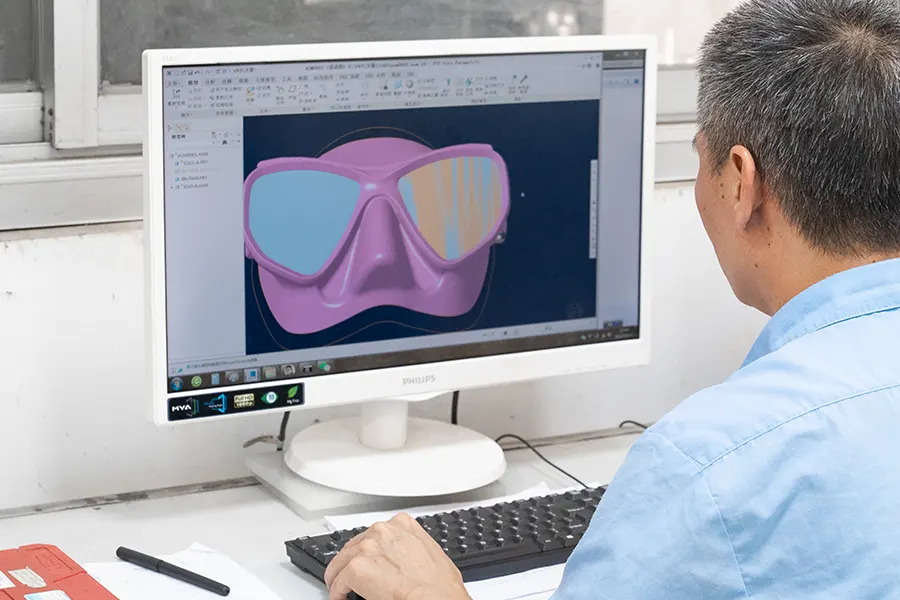
A new pocket is the most common reason a «simple custom fin» quietly becomes a project: molds are cut, установленный, and tested before a saleable prototype exists. With in-house CNC mold development, that work happens under the same roof as production, which is why deep-custom prototypes at Vanguard typically land in 15–30 days including mold time. Ask any supplier whether pocket work is done in-house or subcontracted — the answer shows up later in how fast revisions move.
Graphics options: where your brand actually shows up
Once the hardware is decided, the brand layer is where a custom line earns its shelf presence — and where buyers most often specify something that will not survive saltwater.
Printed logos
Padded printing is the workhorse: durable enough for blade surfaces, good for fine detail, and it works on existing molds. Supply vector artwork (AI or PDF) and Pantone references rather than screenshots; the difference in proof rounds is measured in weeks.
Molded-in branding
Embossed or debossed marks — logo in the pocket, model name in the rail — never peel because they are the part. They live and die with the tool, so they belong on the mold conversation, not the decoration conversation.
Color as brand
Compounded color at the material level gives you translucent smokes, deep mats, and high-vis options that paint cannot match, at no extra tooling cost. It does, однако, multiply your MOQ: color is what the 300-per-color baseline counts.
Ремни, пряжки, и упаковка
Branded strap print, custom buckle color, and a finished retail box with your artwork are the cheapest perceived-premium upgrades available. For e-commerce and resort-program channels, a good box does more for unboxing reviews than a fifth percent of blade stiffness.
What each customization level costs you in time and volume
Translated into planning numbers, the four rungs look like this. Timelines are Vanguard’s documented working ranges; confirm anything contract-critical against your own quote.
| Customization level | Tooling needed | Volume reality | Typical path |
|---|---|---|---|
| Logo print + packaging on existing model | Никто | Starts near the 300 pcs/color baseline | Stock sample 2–7 days, затем производство |
| Custom colors / material grade | None to minor | Per-color MOQ applies to each colorway | Compounding proofs, then 30–60 day production |
| Component mix (карман + blade options) | Existing platform tooling | Splits volume across shared parts | DFM check 24–48 h, sample round, then run |
| New blade or pocket geometry | Новая форма | Needs multi-season volume to amortize | Prototype 15–30 days incl. форма, MP 30–60 days |
On the money side: first-order mass production runs 30–60 days, with reorders typically compressing toward 30 days once tooling and color recipes are proven. Molds and original designs sit under NDA protocols, and standard private-label models carry no mold fee on repeat orders — which is precisely the argument for building a program on shared, proven tooling and spending your new-mold budget only where geometry is the product.
When does a new mold actually earn its keep?
Three honest triggers justify new tooling on a custom fin line. Первый, platform plays: an interchangeable pocket or a signature blade you will sell across several seasons and price points, where exclusivity protects margin. Второй, a real performance claim: a flex pattern or pocket volume that existing tools cannot produce and your target diver will pay to feel. Третий, category entry: dive-school or resort programs sometimes need a durable, serviceable configuration the retail catalog does not carry.
Everything else — a nicer logo position, a shade of blue — is reachable on someone’s already-paid-for mold. The wholesale economics of blade materials are broken down in our freediving fins wholesale pricing guide, and the broader custom program structure, from artwork to container, sits in our custom manufacturing service page if you want the process view before you scope a range.
Часто задаваемые вопросы
What is the minimum order for custom freediving fins?
For customization on established fin tooling — logo print, brand colors, packaging — the working baseline is around 300 штук каждого цвета, in line with our documented MOQ for masks, очки, и плавники. Programs requiring new blade or pocket molds are quoted individually, because the mold cost and the first-production volume need to be planned together.
Can I get my logo on a freediving fin without a new mold?
Yes — that is the entry level of customization. Padded print on the blade or pocket, compounded color choices, and branded packaging all apply to existing mold platforms, so no tooling budget is involved. What you cannot do without new tooling is change the geometry itself: embossed marks, blade contour, and pocket volume are features of the mold.
How long does a fully custom fin program take?
A typical sequence: DFM feasibility feedback within 24–48 hours of design submission, stock or pre-production samples in 2–7 days for existing models, deep-custom prototypes in 15–30 days including mold cutting, затем 30–60 дней для первого массового производства. Repeat orders on proven tooling usually shorten to about 30 дни.
Is my custom fin design protected from copycats?
Molds and original designs are handled under strict NDA protocols, and the factory has decades of brand-account work behind that discipline. The stronger protection, хотя, is structural: a blade or pocket that only exists on your tooling cannot be pulled from a shared catalog line, which is why platform-level custom molds reward brands planning multi-season volume.
Blade angle, карман для ног, or graphics — what should I customize first?
Most programs should start with graphics and color, because they build brand recognition at existing-mold economics. Move to component mixing when you want a range rather than one model, and reserve new blade-angle or pocket tooling for products where a measurable performance or fit difference justifies the mold spend.