Fog is the single most common complaint swim retailers hear at the returns counter, and it is also the complaint most likely to damage a private label before its second season. A goggle can seal perfectly, feel comfortable, and still get returned week after week because the lens fogs after ten laps. When retail buyers audit their goggle category, the anti-fog claim on the packaging deserves as much scrutiny as the strap or the silicone skirt.
This comparison of anti fog coated vs molded-in goggles lays out how each route works, where each one fails, and what evidence you should demand from a factory before you commit a production order. We write from the manufacturing side: our factory runs both coating lines and integrated molding, so the trade-offs below are the ones we discuss with retail buyers every week.
Key Takeaways
- Anti-fog coatings are hydrophilic surface layers — effective when new, but gradually worn down by wiping, Chlor, and UV exposure; they are a cost-driven choice for entry price points.
- Molded-in anti-fog integrates the fog-management function into the lens system during molding, with no separately applied layer to wear off — the route our patent-protected silicone co-injection process is built around.
- For retail, the durability gap translates into different return profiles, warranty positions, and achievable price tiers, not just different unit costs.
- Before ordering, verify claims with evidence: anti-fog duration data in the inspection report, steam-test samples, and a chlorine-exposure protocol — not marketing wording on a spec sheet.
What Is an Anti-Fog Coating — and Why Does It Wear Off?
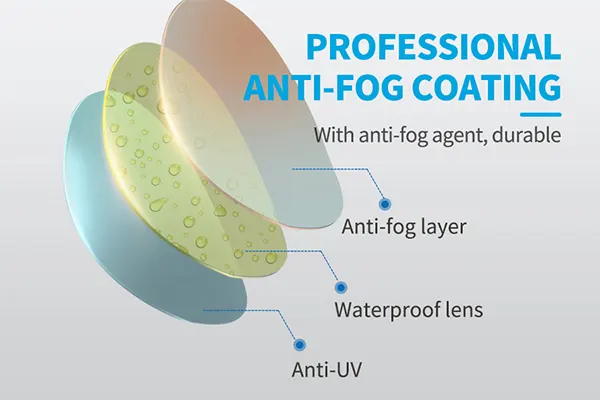
A coated lens gets its anti-fog behavior from a thin hydrophilic layer applied to the inner surface after the lens is molded. The layer works by pulling condensed water into a continuous, invisible film instead of letting it scatter into the droplets a swimmer perceives as fog. When the layer is intact and fresh, performance is genuinely good — this is why coated goggles test well out of the box and why the technology remains the volume standard for entry-level programs.
The weakness is that the function lives in a layer measured in microns, and that layer is exposed to everything the swimmer does. Three degradation paths dominate:
- Mechanical abrasion. Fingertip wiping, towel contact, and rubbing inside a gear bag all remove hydrophilic material. Most manufacturers print „do not wipe the inner lens“ warnings for exactly this reason — and most swimmers ignore them.
- Chemical attack. Chlorinated pool water, sunscreen residues, and aggressive cleaning agents gradually break down the coating’s water-attracting chemistry. Pool-school and swim-academy programs see this fastest, because goggles live in chlorinated water five or more sessions a week.
- Aging in the channel. A coating has a practical shelf life. Hydrophilic layers slowly lose effectiveness in humid warehouse and display-cabinet environments, which means a goggle that tested well at the factory may already be below spec by the time it reaches a shelf on another continent.
Real customer feedback mirrors this pattern. In the verified review data we track for our own goggle lines, complaints about lenses going blurry mid-swim cluster months after purchase rather than on first use — the signature of a coating degrading in service, not a manufacturing defect on day one. For a retail buyer, that timeline matters: the failure tends to land after the return window, converting a product weakness into a brand-trust problem instead of a claimable defect.
What Does „Molded-In“ Anti-Fog Actually Mean?
The molded-in route moves the fog-management function inside the lens system itself, during the molding stage, instead of applying it as a secondary surface treatment. In der Praxis, suppliers describe several variants under this umbrella, so it is worth asking precisely what a factory means. The variant we build at Vorhut is the one our materials engineering is known for: silicone-to-lens integration through co-injection. Flüssiger Silikonkautschuk (LSR) and the lens assembly are joined in a single precision molding operation, producing a sealed optical unit with no adhesive boundary near the lens surface and no separately applied fog layer that a swimmer can wipe away.
Two consequences follow from that architecture. Erste, because the interface is created in the mold rather than on a finishing line, the fog-related performance is consistent unit to unit — machine-controlled molding does not have the operator-to-operator variation you get with spray-and-cure coating lines. Zweite, the sealed unit changes what degradation even means. A coating fails when its surface is removed; an integrated lens system has no such removable layer, so aging attacks the bulk material properties that molding already controlled. That is the durability argument in one sentence: you cannot wear off a function that was never a separate layer.
Our co-injection process is patent-protected, and it is the same platform behind the leak-proof performance we supply to brand and chain-store customers — you can read how the co-injection technology removes the adhesive boundary that causes both fog and leak complaints. Buyers evaluating the molded-in route should treat „integration“ as the keyword: the fewer post-molding joining and spraying steps near the lens, the fewer degradation boundaries the product carries.
Coated vs Molded-In: Which Survives a Retail Season Better?
The honest summary is that both routes can pass a factory fog test on the day of inspection. They separate over time — in the pool, in the display cabinet, and in the returns log. The table below compares them on the dimensions retail buyers actually price into a program:
| Dimension | Anti-Fog Coated Lens | Molded-In (Integriert) Lens System |
|---|---|---|
| How the function is created | Hydrophilic layer sprayed and cured onto the finished lens | Fog-management built into the lens system during precision molding (Z.B., Silikon-Co-Injektion) |
| Out-of-box fog performance | Good — passes steam tests when fresh | Good — comparable on day one |
| Resistance to wiping | Low — wiping removes the active layer | High — no separately applied layer to remove |
| Chlorine and UV aging | Degrades progressively with pool hours | Aging acts on bulk material, which molding already controls |
| Unit-to-unit consistency | Varies with spray-and-cure line discipline | Machine-controlled molding, tighter spread |
| Shelf-life risk before sale | Real — hydrophilic layers weaken in humid storage | Lower — no applied layer decaying in the cabinet |
| Typical retail positioning | Entry and mid price points, price-led programs | Mid-premium and brand programs, warranty-led claims |
| Tooling and unit cost | Lower — standard lens plus finishing line | Higher — precision molds and integrated molding investment |
| Best fit | High-turn promotional lines where price wins the shelf | Lines where repeat purchase and review scores drive growth |
How Do Fog Complaints Turn into Retail Margin Loss?
A foggy-lens return is more expensive than the refund. By the time a customer brings the goggle back, the retailer has absorbed reverse logistics, restocking or write-off, and front-line staff time — and if the customer instead keeps the goggle but never returns to the category, the cost quietly moves to lifetime value instead of the returns line. Either way, the money is gone.
Three knock-on effects make fog complaints disproportionately costly compared with, say, a strap complaint:
- Review contamination. Fog complaints surface as one-star „can’t see underwater“ reviews that a buyer reading the listing cannot distinguish from a fit or quality problem — the review punishes the whole product, not the coating.
- Warranty ambiguity. „The anti-fog stopped working“ sits in a gray zone: it is not visibly broken, so chains argue over whether it is a defect. Integrated systems give the seller a cleaner story, because there is no consumable layer whose „wear“ can be blamed on the user.
- Repeat-purchase suppression. Goggles are a habitual repurchase category. A shopper burned by fog does not switch models within your brand — they switch brands at the shelf.
This is why durability is a pricing question, not a quality-department question. A molded-in program that holds a reliable price point across two seasons can out-earn a cheaper coated program whose review score drifts down after month four.
How Do You Verify Anti-Fog Claims Before Committing an Order?
Every supplier claims anti-fog performance. The differentiator is which supplier can show you evidence in a format your QA team can re-test. Use this checklist during supplier evaluation — it mirrors what we provide in our own first-article and outgoing inspection packages:
- Ask for anti-fog duration data inside the inspection report. Our first article inspection (FAI) and outgoing quality control (OCC) documentation includes anti-fog duration results alongside leak-tightness and pull-force data. If a supplier’s QC report has no anti-fog line item at all, the claim is marketing, not measurement.
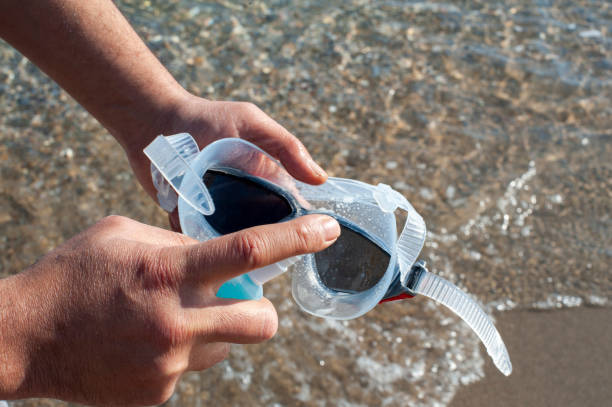
- Run your own steam test on random samples. Hold sample goggles over warm water and time the fog-free interval. Then wipe the inner lens once with a soft cloth and repeat. A coated lens shows an immediate gap between the two runs; an integrated system should not. Pull samples from different production dates if possible — you are testing line consistency, keine goldene Probe.
- Specify a chlorine-exposure protocol for the golden sample. Agree in writing how many pool-hours (or laboratory chlorine cycles) the anti-fog function must survive, and make it an acceptance criterion for mass production, not a brochure sentence.
- Ask what the lens boundary is made of. If the answer involves an adhesive line near the lens, expect both fog and leak risk to age together — boundary failure is a shared root cause. Co-injection integration exists precisely to remove that boundary.
- Check the certificates behind the materials. Fog treatments touch the eye area, so material compliance is part of the claim: ask for CE and FDA documentation for the lens and treatment materials, plus OEKO-TEX Standard 100 coverage where the market expects it.
Buyers who want a broader supplier-audit framework can pair this checklist with the seven-point sourcing checklist we published for dive masks — the verification logic is the same across molded eyewear categories.
Which Anti-Fog Route Fits Your Retail Lineup?
Neither route is „besser“ in the abstract — they are built for different commercial jobs. Use three questions to decide:
- What does the shelf fight on? If your goggle bay competes on price with heavy promotional rotation, coated lenses keep landed cost down and the durability trade-off is priced in. If the line competes on review scores and repeat purchase, integration protects the asset that matters.
- What return policy does the retailer carry? Chains with generous no-questions returns internalize every fog complaint as a cost. Private labels selling through stricter retailers can price coated programs rationally.
- How long will the SKU live? A one-season promo SKU never meets its own aging curve. A core SKU that must hold a 4-plus review rating for two years cannot afford a degradable layer.
Many of our retail customers run a two-tier answer deliberately: coated models at entry price points to cover the promotional bay, and co-injection integrated models — like the platform behind our swimming goggles range — as the signature tier the brand hangs its reputation on. The split lets the price-sensitive shopper in the door while giving the review-reading shopper a reason to trade up.
Häufig gestellte Fragen
Do anti-fog coatings eventually wash off?
Yes — that is the route’s known limitation. Hydrophilic coatings are gradually removed by wiping, chlorine exposure, and cleaning agents, and they also weaken during long storage. That is why we supply coated models for entry price points and integrated systems for programs where durability claims must hold.
Are molded-in anti-fog goggles significantly more expensive?
Unit and tooling costs run higher because precision molds and integrated molding lines replace a simple finishing spray. Most retail buyers recover the difference through fewer fog-related returns, a cleaner warranty position, and the ability to hold a premium price tier across seasons.
Can I get anti-fog test data before placing a production order?
Ja. Our inspection documentation includes anti-fog duration results together with leak-tightness and pull-force data, and stock samples ship in 2–7 days so your team can run independent steam and wipe tests before committing to tooling.
Will integrated anti-fog goggles still fog in cold open water?
No lens system is immune to the physics of a big temperature difference between skin and water. Integrated systems resist fog longer and degrade far more slowly than coatings, but in extreme cold-water conditions a brief fog cycle can still occur. The difference is whether performance survives the season, not whether physics is suspended.
What is the MOQ for a custom anti-fog goggle program?
For goggle programs our standard starting point is 300 Stück pro Farbe, with custom prototypes taking 15–30 days including tooling and mass production 30–60 days after sample approval. Repeat orders typically run around 30 Tage. Exact terms depend on the specification, so share your target spec for a confirmed quotation.