Wholesale buyers treat snorkeling fins as an easy line to add — until the first container quote lands. Fins are light for their size, which means you are not paying for weight; you are paying for the cubic meters each carton occupies. A product that looks cheap per unit can become expensive per shipped pair once retail boxes, void fill, and non-nesting blade shapes eat into your container space.
This guide breaks down the three numbers that actually decide whether a snorkeling fins wholesale program works: the MOQ you must commit to, the price tiers attached to those quantities, and the container loading math that determines your landed cost. Everything below reflects how factory-direct suppliers in this category structure their offers, including our own production terms at Vanguard-Schwimmen.
Key Takeaways
- Standard MOQ for fins at most factory-direct suppliers starts around 300 pcs per color — confirm per-model minimums before committing your assortment.
- Fins are volumetric cargo: container efficiency depends on carton dimensions and packaging format, not on product weight.
- Price tiers reward color consolidation and repeat orders, not just raw quantity — the structure of your SKU list matters as much as its size.
- Stock programs ship in as little as 48 Std.; custom and private-label runs follow a 30–60 day mass production cycle after sample approval.
- Always request carton dimensions and CBM per carton before placing the order, then verify loading counts against your container type.
What Wholesale Terms Look Like for Snorkeling Fins
Every fin program starts with the same three questions: how many units, in how many colors, and against which delivery timeline. In unserer Fabrik, the baseline minimum for fins sits at 300 pieces per color — the same per-color threshold we apply to masks and goggles. That number exists for a production reason: each color change on an injection-molding line involves material changeover, purge cycles, and first-article re-verification, so anything smaller than that threshold costs more per unit to set up than the margin supports.
Für Käufer, the practical implication is that your color strategy drives your real entry point. A program of 900 pieces split across three colors fits the minimum; the same 900 pieces split across nine colors does not. Most distributors consolidate to two or three proven colorways at launch, then expand the palette on reorder once sell-through data justifies the commitment.
Delivery terms follow the program type. Stock samples dispatch within 2–7 days, and ready-to-ship inventory leaves the warehouse within 48 hours of payment confirmation — useful for cross-border sellers testing demand before committing to volume. Custom and private-label programs follow the engineering path: 15–30 days for prototypes, then 30–60 days for first mass production, with repeat orders compressing to roughly 30 days since tooling and golden samples already exist. If you are comparing suppliers, criteria for choosing diving fins at wholesale — blade recovery, strap durability, foot-pocket consistency — matter as much as the commercial terms themselves.
How Price Tiers Are Actually Structured
Fin pricing is not a single number that falls as volume rises. It is a stack of variables, and each one moves the unit price independently:
| Variable | Effect on Unit Price | Buyer Lever |
|---|---|---|
| Quantity per SKU | Larger runs amortize setup and changeover costs | Consolidate sizes and colors into fewer, deeper SKUs |
| Color count | Each additional color adds changeover cost at any quantity | Launch with 2–3 colorways; expand on reorder |
| Klingenmaterial | Polymer blades cost less than composite or carbon options | Match material to the price tier of your retail channel |
| Packaging format | Printed color boxes, blisters, and hang cards add per-unit cost | Start with bulk polybag; add retail packaging on proven SKUs |
| Tooling status | New custom molds carry one-time tooling cost; standard models do not | Use existing mold library for first orders; no mold fees apply on repeat private-label runs of standard models |
| Stock vs. custom | Stock programs price lower and ship in 48 Std.; custom carries engineering amortization | Blend both: stock for velocity, custom for differentiation |
Two structural points are worth negotiating explicitly. Erste, tier pricing should be quoted per color-run, not just per order — otherwise your color consolidation work disappears into a blended price. Zweite, repeat orders of standard private-label models should not re-trigger mold fees; make that a written line in your supply agreement. Buyers who also run mask or goggle programs can usually negotiate cross-category tiers with a single factory, since the per-color minimums and quality gates are shared — the same logic applies to dive mask wholesale pricing structures.
Why Fins Are Volume Cargo: Container Loading Math
A snorkeling fin pair in bulk polybag weighs little — a few hundred grams — but measures over half a meter in length depending on blade size. Ocean freight is charged by container, so your true unit cost is set by how many pairs fit in the space you paid for. This is why packaging format is a freight decision, not just a marketing one.
The working method is straightforward. Ask your supplier for the carton dimensions (length × width × height, in meters) and the pairs per carton. Multiply to get CBM per carton, divide the usable container volume by that figure, and multiply by pairs per carton. Industry-standard usable volumes run to approximately 28 CBM for a 20GP, 58 CBM for a 40GP, Und 68 CBM for a 40HQ — never plan to the theoretical maximum, because blade-shaped cartons never tessellate perfectly and floor-loading patterns leave gaps.
A worked example, using round numbers purely for illustration: if a bulk-packed fin carton measures 0.65 × 0.50 × 0.35 m and holds 10 Paare, each carton occupies about 0.114 CBM. A 20GP at 28 usable CBM then holds roughly 245 cartons, or about 2,450 Paare. Switch the same fins to individual printed color boxes with void fill, and carton density typically drops by 20–35% — your 2,450 pairs may become fewer than 1,900 in the same container, raising freight cost per pair by the same proportion. Treat these figures as a calculation template and confirm actual counts with your supplier’s packing specification before ordering.
Packaging Formats That Change Your Loading Efficiency
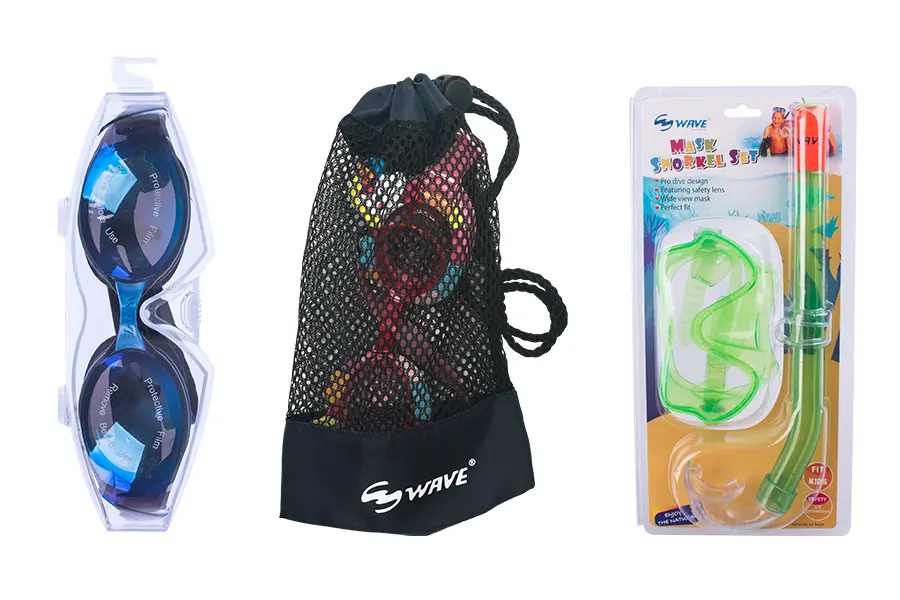
The three common formats each trade cost against cube:
| Format | Cube Impact | Best Fit |
|---|---|---|
| Bulk polybag | Most compact; pairs nest tightly | Distributors repacking locally; e-commerce fulfillment centers |
| Printed color box | Adds 20–35% cube vs. bulk in most cases | Retail shelf placement; big-box and chain programs |
| Hang card / Blase | Highest cube per pair; designed for display, not density | Sporting-good peg walls; resort pro shops |
Private-label packaging follows its own decision path — artwork, compliance labeling, Barcodes, and language versions — and the same carton-level thinking applies when you specify box dimensions. If packaging strategy matters to your program, the planning framework in our snorkeling set packaging and branding guide covers the retail-side trade-offs in detail.
Quality Gates and Pre-Shipment Checks on Bulk Fin Orders
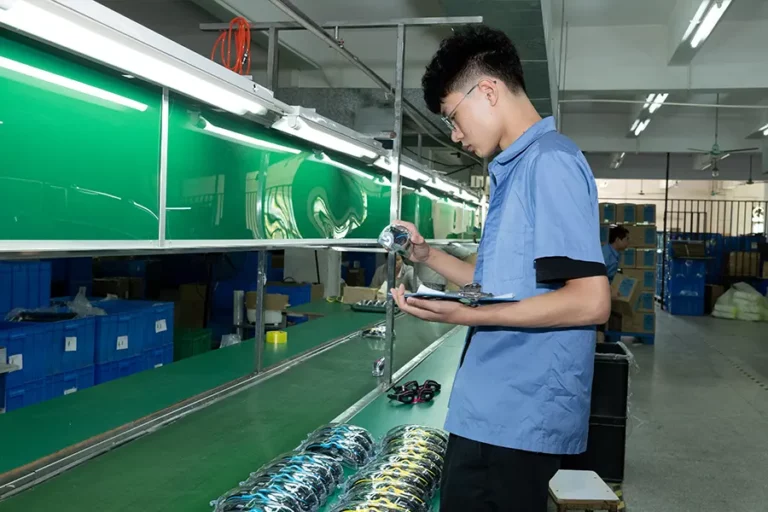
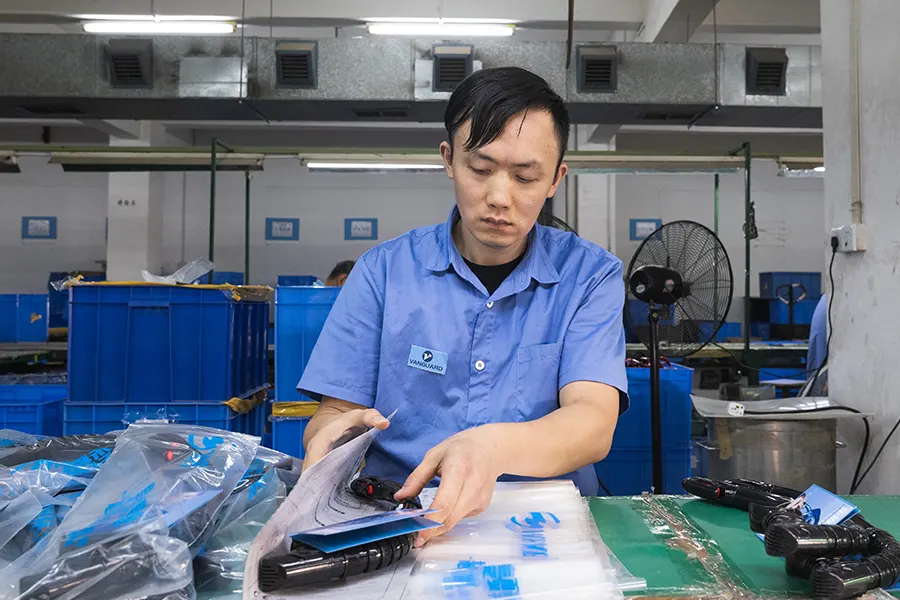
Volume without inspection is a returns problem waiting for peak season. A factory-direct fin program should pass four quality gates: Wareneingangskontrolle (IQ) on resins and strap components, in-process checks (IPQC) during molding and assembly, full final inspection (FQC) covering strap pull strength and blade recovery, and an outbound audit (OCC) of carton count, Markierung, and packing spec before loading. Our own lines run exactly this sequence, documented per batch with traceable lot numbers on export packaging.
Ask for the inspection plan in writing before you wire a deposit, and specify which checks matter for your market — strap anchor fatigue and blade snap-back are the two failure modes that generate most fin returns at retail. Certification requirements (CE marking for the EU, FDA-relevant material statements for food-contact-adjacent components like mouthpieces in set programs) should be confirmed against your destination market rather than assumed; unser quality and certifications page listet die Standards auf, die wir derzeit anwenden, einschließlich ISO 9001:2015, BSCI, CE, FDA, und OEKO-TEX-Standard 100.
Lead-Time Planning Around Your Selling Season
Work backwards from your shelf date. First mass production runs 30–60 days after sample approval, to which you add ocean transit, destination customs, and inbound handling. For a Northern-Hemisphere summer season, that places the order window in the first quarter — and since every buyer in the category is solving the same equation, factory slots tighten months earlier. Repeat orders shorten the production leg to roughly 30 Tage, and ready-to-ship stock dispatches within 48 Std., which is how experienced distributors bridge a mid-season stockout without air freight.
Suppliers serving both hemispheres feel two demand peaks each year: the Northern-Hemisphere beach season from late spring through summer, and the Southern-Hemisphere and resort-market high season that ramps from October through the New Year. A distributor with mixed channels should stagger orders against both curves rather than doubling up on one. The planning grid below maps a typical cycle:
| Fenster | Buyer Action | Why It Matters |
|---|---|---|
| Q1 (Jan–Mar) | Finalize assortment, approve samples, place first mass-production order | 30–60 day production plus ocean transit lands goods before the Northern summer |
| Q2 (Apr–Jun) | Receive goods; place repeat order on early sell-through winners | Repeat runs compress to about 30 Tage; still time to restock mid-season |
| Q3 (Jul–Sep) | Review season data; lock next year’s palette and packaging changes | Artwork and color changes need engineering time before the next cycle |
| Q4 (Oct–Dec) | Ship Southern-Hemisphere and resort orders; bridge gaps from ready-to-ship stock | 48-hour dispatch on stock covers spikes without air freight |
One more planning habit pays for itself: keep your approved golden samples and inspection reports current across seasons, because a re-order placed against an outdated reference is the most common cause of quiet quality drift in year two of a program.
Häufig gestellte Fragen
What is the typical MOQ for wholesale snorkeling fins?
At our factory the standard minimum is 300 pieces per color for fins, matching the per-color thresholds we apply to masks and goggles. The effective entry quantity depends on how you split colors and sizes: fewer, deeper SKUs reach better pricing than a wide assortment at the same total volume.
How many pairs of snorkeling fins fit in a container?
It depends entirely on carton dimensions and packaging format, so request the packing specification before ordering. As a calculation method: carton CBM into usable container volume (approximately 28 CBM for a 20GP, 58 for a 40GP, 68 for a 40HQ), multiplied by pairs per carton. Bulk polybag packing ships meaningfully more pairs per container than boxed retail formats.
Do price tiers apply per order or per color?
Negotiate tiers per color-run where possible, because that is where production changeover costs actually sit. A supplier quoting only blended order-level tiers may be averaging away the savings you earned by consolidating your palette — put the per-color basis in writing.
Can I mix fins with masks and goggles in one wholesale program?
Yes — mixing categories within one factory program is common and often improves terms, since per-color minimums and quality gates are shared across product lines. Combined set programs (Maske, Schnorchel, Flossen) also simplify container planning because mixed cartons balance bulk efficiently.