Every swim retailer knows the conversation. A customer buys a pair of goggles in March, and by June they are back at the counter asking why the lenses cloud up after ten laps — and whether that counts as a defect. Anti-fog performance is invisible at the moment of purchase, decisive in the first month of use, and it drives a disproportionate share of goggle returns and one-star reviews across the category.
For swim specialty retailers and e-commerce sellers, understanding how anti fog swim goggles actually work is not lab trivia — it is shelf strategy. The two dominant technologies, factory-applied coatings and molded-in anti-fog layers, behave differently out of the box, age differently over a season, and support different price positions. This guide explains both routes in plain language, then translates the science into the questions buyers should put to suppliers before committing inventory.
Principais conclusões
- Fog forms when warm, humid air meets a cooler lens surface — goggle design, chemistry, and user habits all decide how often that happens.
- Coated lenses rely on a factory-applied hydrophilic film that spreads condensation into a see-through sheet; the film wears out with chlorine exposure, wiping, and time.
- Molded-in anti-fog layers integrate the fog control into the lens material itself, trading higher unit cost for longer effective life.
- Anti-fog performance is a specifiable OEM parameter — established manufacturers accept anti-fog level requirements as part of custom input, alongside color and lens function.
- Quality inspection reports can include anti-fog duration data; request it during supplier evaluation instead of comparing marketing claims.
Why Do Swim Goggles Fog Up in the First Place?
Lens fog is a physics problem before it is a product problem. The air trapped between a swimmer’s face and the goggle lens is warm and humid — loaded with moisture from skin and breath. The lens itself sits in cooler pool water. When that warm humid air meets the cooler lens surface, water vapor condenses into thousands of microscopic droplets. Each droplet scatters light, and the result is the milky haze swimmers describe as “fogged up.”
Two factors make swim goggles unusually fog-prone compared with other eyewear. Primeiro, the sealed micro-climate inside the goggle cup keeps humidity close to 100 percent — there is nowhere for moisture to go. Segundo, the temperature differential between face and water is often at its worst exactly when the workout is hardest: high exertion means warmer exhaled air and more condensation. That is why fog complaints cluster among fitness and competitive swimmers rather than casual beach users, and why the category demands an engineering answer rather than a marketing one.
Condensation itself cannot be eliminated — but it can be managed. Micro-droplets scatter light; an unbroken thin film of water does not. Every anti-fog technology on the market, from factory coatings to aftermarket sprays, is a variation on one strategy: force condensation to form a uniform wetting layer instead of light-scattering beads. The difference between technologies is how long they keep doing it.
How Do Anti-Fog Coatings Work — and Why Do They Wear Out?
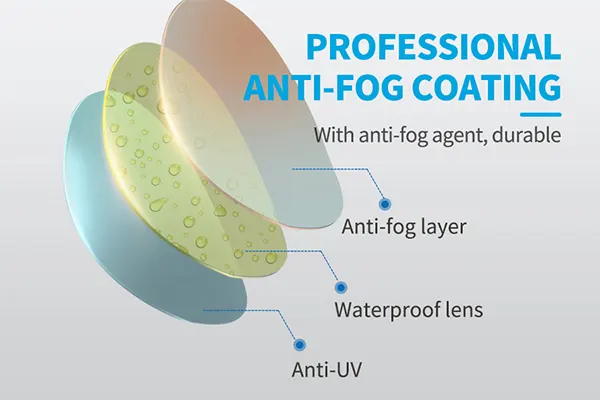
The coating route is the industry’s volume solution. At the factory, the inner surface of the molded lens is treated with a hydrophilic agent — a film that loves water. Instead of beading, condensation spreads across the treated surface into a thin, transparent sheet. Vision stays clear because the water layer is thinner than a human hair and optically quiet.
The trade-off is durability. The hydrophilic film sits on the surface, which means everything that touches the surface touches the film. Chlorine and pool chemicals gradually degrade it. Fingernail cleaning and towel drying scratch it away. Ultraviolet exposure and simple age break down its chemistry. A well-made coated lens performs strongly out of the box, then fades over weeks to months of regular use — which is precisely the pattern behind the “great goggles, until they weren’t” review arc that retailers know too well.
Importantly, coating wear is not a defect in a well-specified product; it is the known life cycle of the technology. That is why care guidance — rinse in fresh water, never wipe the inner lens, store dry — has real commercial value for retailers: it stretches the effective life of the coating and defuses warranty conversations. Aftermarket anti-fog sprays and drops essentially replenish the same hydrophilic chemistry, restoring performance for consumers who want to extend a favorite frame’s life rather than replace it.
What Is Molded-In Anti-Fog Technology?
The molded-in route moves fog control inside the lens itself. During lens production, the anti-fog agent is compounded into the lens material or applied as an integrated layer during the molding process, rather than deposited on top of a finished surface. The fog-controlling chemistry becomes part of the lens structure instead of a skin on it.
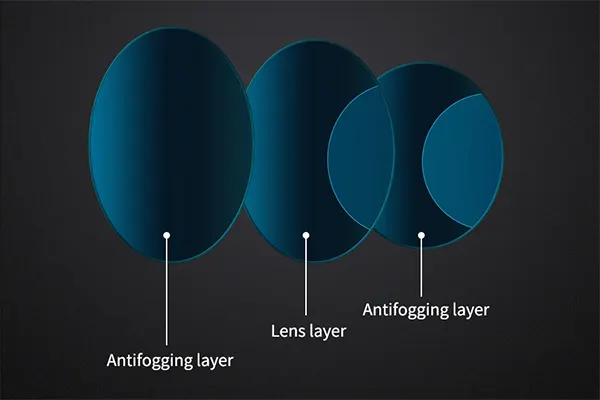
The consequence is longevity. Because the active material is not a surface film, routine enemies of coatings — wiping, chlorine contact, degradation from the water line inward — attack it far more slowly. A molded-in lens tends to hold its anti-fog performance across a longer service life, which is why the technology usually anchors a brand’s premium tier and appears in goggles positioned for frequent, serious swimmers.
The costs are real, no entanto. Integrating the anti-fog function into the lens compound demands tighter process control in molding, more careful material validation, and more disciplined quality inspection — capabilities that separate established manufacturers from assembly-only workshops. That is also why molded-in product carries a higher factory price and why it earns it: for the retailer, fewer fog-related returns and a longer positive-review window on every unit sold.
| Atributo | Coated Anti-Fog | Molded-In Anti-Fog |
|---|---|---|
| Where fog control lives | Hydrophilic film on the inner lens surface | Anti-fog agent compounded into or integrated within the lens material |
| Out-of-box performance | Strong when freshly applied | Strong and consistent from first use |
| Effective life | Weeks to months of regular use; fades with chlorine, wiping, and age | Longer service life — active material is not a surface film |
| Consumer restoration path | Anti-fog sprays and drops replenish the same chemistry | Rarely needed; standard care rules still apply |
| Unit cost position | Lower — suits volume and entry tiers | Higher — suits premium and frequent-swimmer tiers |
| Best-fit retail slot | Recreativo, júnior, and price-led programs | Fitness, competitive, and brand-flagship programs |
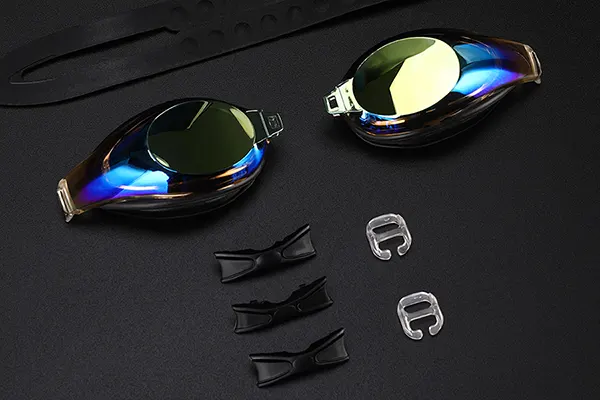
Which Design Features Work Alongside Anti-Fog Chemistry?
Anti-fog technology does not operate alone — surrounding design decisions either protect it or undermine it, and retailers who understand the interactions merchandize smarter.
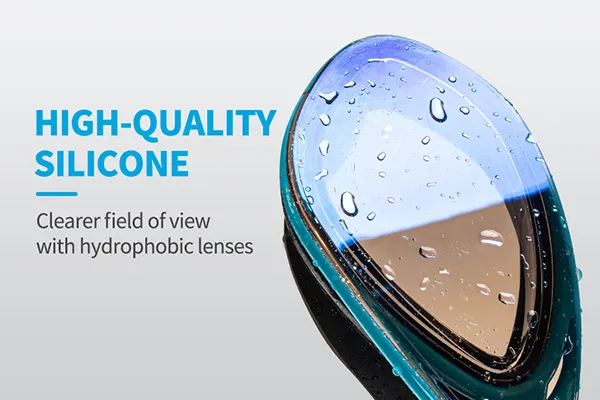
Lens curvature and field of view shape how quickly the micro-climate heats up. Wide-vision lens geometries increase the sealed volume slightly but improve airflow dynamics around the eyes; well-designed single-lens and dual-lens platforms balance the two. Hydrophobic outer-lens treatments, a separate technology from anti-fog, shed water droplets on the outside of the lens for a clearer view in open water — the two are frequently paired in premium models.
Seal quality is the quiet contributor. A gasket that fits the face without pressure points keeps the humid micro-climate where the anti-fog system was designed to manage it. This is where goggle construction intersects with materials engineering: borracha de silicone líquida (LSR) gaskets, and particularly the silicone-to-frame integration achieved with co-injection molding, deliver the consistent seal that keeps the anti-fog system working as intended. O co-injection manufacturing process explains how integrated silicone construction improves both seal reliability and lifespan.
Ventilation offers a structural third route where geometry allows. Máscaras de snorkel de rosto completo, por exemplo, cannot rely on the same tight micro-climate management as compact swim goggles and instead use one-way airflow channels to move humid air out of the viewing chamber — the anti-fog design approach behind the panoramic breathing masks in the watersports category. For swim goggles proper, no entanto, where a water-tight seal is non-negotiable, chemistry-led routes remain the practical answer.
How Should Retailers Handle the Anti-Fog Conversation at the Counter?
Because coating wear is expected behavior rather than early failure, the single most profitable sentence a retailer can deliver at sale is a care instruction: rinse in fresh water after every swim, never wipe the inside of the lens, let it air dry. Staff who explain that the factory anti-fog layer is a working surface — not a permanent coating like window glass — preempt the majority of fog complaints before they become returns.
Merchandising follows the technology ladder. Entry walls can carry coated-lens recreational models where price and turnover lead; a mid tier adds stronger coatings and comfort upgrades; the premium bay carries molded-in anti-fog product for fitness swimmers and triathletes, flanked by aftermarket anti-fog spray as an attach item. Prescription models follow the same logic — the lens platform for óculos de natação prescritos supports the same anti-fog tiering as plano stock. For deeper background on user-side solutions, this guide to fog-proofing goggles covers the seven practical fixes consumers try, and where each one fits.
What Should Buyers Ask a Goggles Supplier About Anti-Fog?
For retailers and e-commerce sellers sourcing directly, five questions separate suppliers who engineer anti-fog performance from those who print it on the box.
- Which technology does each SKU use — coating or molded-in — and at which tier? A supplier who cannot map its own catalog to the two routes is reselling, not manufacturing.
- Can anti-fog level be specified for custom programs? Established OEM manufacturers accept anti-fog level requirements as a standard customization input, alongside Pantone colors, lens functions such as polarization or photochromic treatment, and coating options.
- What does the quality inspection report say about anti-fog? Factory QC documentation can include anti-fog duration test data alongside leak and tensile results — ask to see the report format before ordering, not after a dispute.
- What care guidance accompanies the product? Suppliers who ship printed or digital care instructions reduce your return rate for free.
- What is the recommended aftercare lineup? A manufacturer that also supplies or recommends compatible anti-fog aftercare keeps your customers’ second month as good as their first.
Those questions cost nothing to ask and are difficult to fake. Suppliers with in-house molding, an in-house QC lab, and a documented testing chain answer them with paperwork; the others answer them with adjectives. The full swimming goggles collection shows how tiered anti-fog specifications translate into an actual retail-ready assortment.
Browse the gama de óculos de natação to compare current platforms, then contact the team with your target tiers — anti-fog level, lens function, and color requirements are all specifiable in OEM programs, with inspection reports available.
Perguntas frequentes
What is the difference between coated and molded-in anti-fog swim goggles?
Coated goggles carry a factory-applied hydrophilic film on the inner lens that spreads condensation into a transparent layer; the film wears out over weeks to months of use. Molded-in goggles integrate the anti-fog agent into the lens material itself during production, which costs more but keeps fog control working for a much longer service life.
Why do anti-fog goggles stop working after a few weeks?
On coated lenses, cloro, pool chemicals, wiping the inner surface, and plain aging gradually remove the hydrophilic film — that is the technology’s normal life cycle, not a defect. Rinsing in fresh water after each swim and never touching the inner lens extends it, and anti-fog sprays can replenish the chemistry on a favorite frame.
Can anti-fog performance be specified in an OEM goggle program?
Sim. Anti-fog level is a standard customization input for established manufacturers, submitted alongside color references and lens function choices such as polarization or photochromic treatment. Quality inspection documentation can include anti-fog duration data, so the specified level is verifiable rather than aspirational.
Is a hydrophobic lens the same as an anti-fog lens?
No — they solve different problems on different surfaces. Hydrophobic treatments repel water from the outer lens so droplets roll off in open water; anti-fog systems manage condensation on the inner lens where fog actually forms. Premium models frequently pair both, but one cannot substitute for the other.
Do anti-fog sprays work on any swim goggles?
Anti-fog sprays and drops replenish hydrophilic chemistry on the inner lens and work on most coated goggles once the factory film fades — making them a natural attach sale alongside entry and mid tiers. They are rarely needed on molded-in lenses, where the fog control is built into the material itself.