A dive shop owner in Cozumel and a sporting goods buyer in Munich face the same question every season: how much shelf space goes to snorkeling fins, and how much to scuba fins? The two categories look similar enough that a first-time retailer will lump them together on one planogram. Six months later, the snorkeling fins have sold through twice and the scuba fins are still sitting in the back row, or the reverse.
The technical differences between the two are well documented — blade length, foot pocket design, strap system, material stiffness. What matters to a B2B buyer is how those differences translate into channel fit, price band, margin structure, return rate, and inventory turn. A resort dive shop and a chain sporting goods store should not carry the same mix, and neither should a cross-border e-commerce seller.
This guide is written for the buyer side of the snorkeling fins vs scuba fins decision. It compares the two categories on the dimensions that shape a retail program: design intent, sales channel, price and margin, SKU mix, certification path, and supplier capability. For the diver-side technical comparison — which fin feels better in the water, how the kick cycle differs, what a customer experiences — see our companion piece on snorkel fins vs scuba fins. This article assumes you already know the basics and focuses on what to stock.
Key Takeaways
- Snorkeling fins and scuba fins are separate retail categories with separate price bands, separate channels, and separate return profiles — they should not share a planogram row.
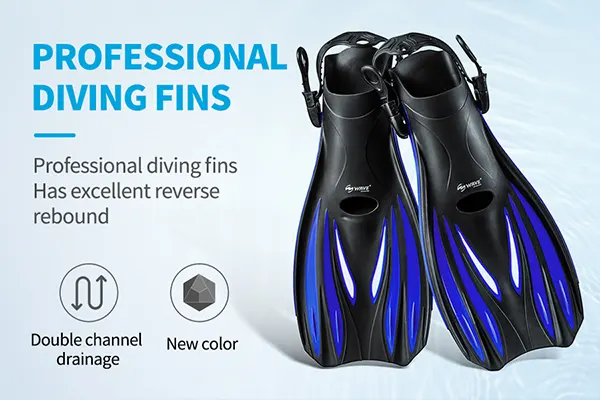
- Snorkeling fins are full-foot, short-blade, and priced at $12 to $55 retail; scuba fins are open-heel, long-blade, strap-based, and priced at $45 to $180 retail.
- Dive shops and resort retail lean snorkeling-heavy; scuba certification centers and technical dive retail lean scuba-heavy; general sporting goods chains run a two-SKU mix.
- Scuba fins carry higher unit margin but slower turn and higher return exposure from sizing and strap failure; snorkeling fins turn faster at lower margin.
- A single supplier producing both categories — with in-house tooling and a shared certification stack — cuts inbound logistics and simplifies a private label program.
Why the Category Distinction Matters for a Retail Program
The two fin categories serve different customers, in different water, at different price points. Treating them as one category on a purchase order is the most common mistake a first-time retailer makes, and it shows up in three places: shelf productivity, return rate, and reorder timing.
Snorkeling fins sell to a casual buyer — a family on a beach holiday, a resort guest, a first-time snorkel tourist. The purchase is often impulse-driven, the price ceiling is low, and the customer expects the fin to work barefoot out of a mesh bag. Scuba fins sell to a certified diver who already owns a wetsuit, a mask, and a regulator. The purchase is considered, the price ceiling is much higher, and the customer expects the fin to fit over a neoprene boot and survive a hundred dives.
A retailer who stocks one category as if it were the other ends up with the wrong size curve, the wrong packaging, and the wrong price tag. The rest of this article breaks down each dimension so you can build a planogram that actually matches your customer.
How Do Snorkeling Fins and Scuba Fins Differ in Design?
The design differences are not cosmetic — each one drives a specific retail behavior. The table below is the working reference most buyers use when comparing supplier spec sheets.
| Design Element | Snorkeling Fins | Scuba Diving Fins | Retail Implication |
|---|---|---|---|
| Blade length | 20–35 cm, short and wide | 55–70 cm, long and stiff | Scuba fins need deeper shelf depth; snorkeling fins fit a standard peg-hook |
| Foot pocket | Full-foot, barefoot wear, soft silicone or TPR | Open-heel, fits over a neoprene boot | Snorkeling fins need a full size run (S–XL); scuba fins need a boot-size chart |
| Strap system | None (full-foot) or plastic buckle (adjustable sub-type) | Spring strap or rust-proof metal buckle, always present | Strap failure is the #1 warranty claim on scuba fins; spring straps cut returns |
| Blade material | PP, TPR, or soft rubber | Stiff PP, composite, or rubber; premium models use carbon fiber | Material choice drives the price band and the target customer segment |
| Weight per pair | 500–1,300 g | 1,500–3,000 g | Scuba fins cost more to ship and need heavier packaging |
| Kick cycle | Short, quick flutter kick at the surface | Long, slow kick driving through depth and current | Marketing copy and in-store demo scripts must match the intended kick |
| Depth rating | Surface and shallow water only | Rated for recreational and technical depth | Liability language on packaging differs; scuba fins need a depth rating on the spec |
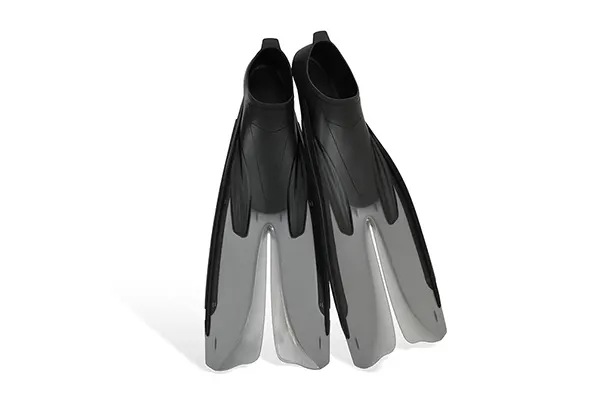
The foot pocket difference is the one that causes the most returns. A customer who buys a scuba fin expecting to wear it barefoot will bring it back within a week. A customer who buys a snorkeling fin expecting to wear it over a boot will do the same. Retail staff training and packaging call-outs matter more here than any other design element. Our three-category fin comparison covers freediving fins alongside the two retail categories, which helps when a store carries all three.
Which Fin Category Fits Which Sales Channel?
Channel fit is the single biggest driver of a fin program’s success. The table below maps each category to the channels where it actually sells, and to the channels where it does not.
Snorkeling fins sell through: resort dive shops, hotel gift shops, beach rental operations, general sporting goods chains, mass retail (Walmart, Decathlon, Target tier), cross-border e-commerce (Amazon, Shopee, Mercado Libre), and tour operator fleets. The buyer is casual, the purchase is often same-day, and the price ceiling is low.
Scuba fins sell through: PADI / SSI certification centers, technical dive retail, specialty dive shops, dive travel operators, and premium e-commerce. The buyer is a certified diver, the purchase is considered over days or weeks, and the price ceiling is much higher. Scuba fins rarely sell through mass retail — the customer who walks into a Decathlon is not buying a $140 pair of open-heel fins.
Both categories sell through: full-service dive shops at tourist destinations, where a single store serves snorkel tourists in the morning and certified divers in the afternoon. These stores need a mixed planogram with clear visual separation — snorkeling fins on peg-hooks at eye level, scuba fins on a deeper shelf below or beside.
For a first-time retailer, the channel question comes before the SKU question. If you are opening a beach-side shop in a snorkel destination, your mix should be 70 to 80 percent snorkeling fins. If you are opening a dive school, the ratio flips. If you are a general sporting goods chain, you carry two or three snorkeling SKUs and one or two scuba SKUs, and you do not pretend to serve the technical diver.
What Does the Price Band and Margin Structure Look Like?
The two categories sit in different economic tiers. Understanding the landed cost, the retail price, and the margin structure helps a buyer negotiate with a supplier and price against local competition.
| Metric | Snorkeling Fins | Scuba Diving Fins |
|---|---|---|
| EXW factory price (per pair) | $3.50 – $14 | $12 – $55 |
| Landed cost (incl. freight, duty) | $5 – $18 | $16 – $70 |
| Typical retail price | $12 – $55 | $45 – $180 |
| Gross margin range | 55 – 70% | 55 – 65% |
| Inventory turn (annual) | 3 – 6× for resort retail; 2 – 3× for chain | 1.5 – 3× for dive school; 1 – 2× for specialty retail |
| Return rate | 2 – 5% (sizing, comfort) | 4 – 8% (sizing, strap failure, boot fit) |
| Seasonal concentration | High — Q2/Q3 in northern hemisphere | Moderate — year-round with certification cycles |
Two things stand out. First, scuba fins carry a higher absolute margin per unit but a slower turn and a higher return rate. A dive school that sells 200 pairs of scuba fins a year at $40 margin per pair earns $8,000; a resort shop that sells 800 pairs of snorkeling fins at $12 margin earns $9,600 with less capital tied up. Second, snorkeling fins are more seasonal. A buyer who over-orders in Q1 will be sitting on inventory in Q4; a buyer who under-orders in Q2 will miss the entire season.
How Should a Dive Shop or Sporting Goods Chain Mix the Two?
There is no single correct SKU mix, but there are three common patterns that work. Each maps to a store type.
Pattern A — Resort dive shop (snorkel-heavy). 70 to 80 percent snorkeling fins, 20 to 30 percent scuba fins. Within snorkeling, carry two sub-types: a lightweight entry fin at $18 to $25 retail and an adjustable fin at $28 to $38. Within scuba, carry one mid-tier open-heel fin at $65 to $95. Total fin SKUs: 3 to 4. This pattern works for stores where 80 percent of foot traffic is snorkel tourists and 20 percent is certified divers booking a fun dive.
Pattern B — Dive school / certification center (scuba-heavy). 20 to 30 percent snorkeling fins, 70 to 80 percent scuba fins. Within scuba, carry two tiers: a student rental fin at $55 to $75 and a graduate purchase fin at $95 to $150. Within snorkeling, carry one compact fin for students who also snorkel. Total fin SKUs: 3 to 4. This pattern works for stores attached to a PADI or SSI center where the primary customer is a student or a newly certified diver.
Pattern C — General sporting goods chain (balanced, limited SKUs). 60 percent snorkeling fins, 40 percent scuba fins, but only two or three total SKUs. One lightweight snorkeling fin at $20, one adjustable snorkeling fin at $35, one entry-level scuba fin at $75. This pattern works for a chain that serves a broad customer base and cannot afford deep inventory in a specialty category.
Across all three patterns, the buyer should insist on a supplier who can produce both categories under one PO, one carton spec, and one certification stack. Splitting the order across two factories doubles the inbound logistics, doubles the compliance paperwork, and makes a private label program twice as hard to coordinate. Our wholesale diving fins sourcing guide covers how to score a supplier on this dimension.
Which Certifications and Compliance Documents Apply?
Both fin categories fall under the same regulatory umbrella — recreational swim equipment, not personal protective equipment rated for life support. But the documentation burden differs because of the target market and the age profile of the customer.
Snorkeling fins are often marketed to families and children, which triggers CPSIA (Consumer Product Safety Improvement Act) in the US and EN 71 (toy safety) at the discretion of an EU customs inspector if the packaging looks like a children’s product. OEKO-TEX Standard 100 is increasingly requested by European chains as a consolidated chemical-safety report. CE marking applies where the fin is sold as recreational swim equipment.
Scuba fins are marketed to certified divers, which lowers the children’s-product exposure but raises the depth-rating and liability question. A scuba fin sold without a stated depth rating or a material spec sheet is harder to defend in a warranty claim. BSCI (Business Social Compliance Initiative) factory audits are standard for EU chain retail regardless of category.
Vanguard holds ISO 9001:2015, BSCI, CE, FDA, and OEKO-TEX Standard 100 across the fin category, which means one certification stack covers both snorkeling and scuba programs. For a buyer consolidating a two-category fin order, this removes the need to reconcile two factories’ compliance documents. Our export certifications guide walks through each document in more detail.
Where Does Vanguard Fit in a Two-Category Fin Program?
Vanguard Swimming is a Guangzhou-based manufacturer with three decades of export experience and a 100 percent in-house factory running four production lines and 65 injection molding machines. The facility produces both snorkeling fins and scuba-style open-heel fins, along with dive masks, snorkels, swim goggles, silicone caps, and freediving fins — which means a two-category fin program can ship under one PO with one carton spec.
Three capabilities matter specifically for a buyer comparing snorkeling and scuba programs:
- In-house CNC mold development. Blade geometry, foot pocket contour, and strap anchor points are the three features a private label buyer most often wants to customize. Vanguard runs tooling in-house, which shortens the mold iteration cycle from the 6-to-8-week industry average to 3-to-5 weeks.
- Patented silicone co-injection. The same co-injection process used on our dive masks and goggles applies to fin foot pockets where silicone is over-molded onto a rigid blade core. This is the difference between a foot pocket that delaminates after one season and one that survives a hundred dives — the #1 warranty driver on scuba fins.
- MSF set capability. Because we also produce masks and snorkels, a snorkeling fin can ship as part of an MSF (Mask + Snorkel + Fins) set under one private label carton. Scuba fins ship separately, but the same factory relationship covers both. See our dive mask catalog for the mask side of an MSF program.
You can browse the current snorkeling fins catalog and freediving fins catalog for stock sub-types, or reach out through the contact form to compare a two-category program side by side.
Frequently Asked Questions
Can a retail store stock only snorkeling fins and skip scuba fins entirely?
Yes, and for many resort retail and general sporting goods locations it is the right call. Snorkeling fins turn faster, require less shelf depth, and carry a lower capital commitment. A store that skips scuba fins gives up the higher unit margin but avoids the slower turn, the deeper size curve, and the strap-failure warranty exposure. Dive schools and specialty dive retail should carry both; beach-side gift shops and mass retail usually should not.
What is the most common return reason on scuba fins, and how does a buyer reduce it?
Strap failure and boot-fit sizing are the top two. Strap failure is a supplier decision — insist on spring straps or rust-proof metal buckles, not plastic side-release buckles, for any scuba fin you carry. Boot-fit sizing is a retail decision — print a boot-size chart on the packaging and train staff to ask the customer what size wetsuit boot they wear before recommending a fin size. Together these two changes typically cut the scuba fin return rate from 6–8 percent down to 3–4 percent.
Should a cross-border e-commerce seller carry both categories?
Most cross-border sellers do better starting with snorkeling fins only. The lower unit price supports the shipping cost, the lighter weight keeps the fulfillment profile compact, and the casual buyer converts faster on a marketplace listing. Scuba fins make sense for a seller who already has a dive-focused brand and an audience that searches by certification level. Vanguard’s ready-to-ship program covers both categories with 48-hour stock dispatch, which matters for a seller testing a new listing.
How do freediving fins fit into a two-category fin program?
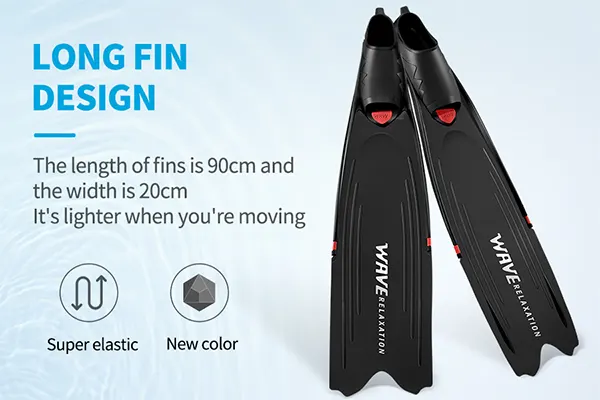
Freediving fins are a third category, not a sub-type of scuba fins. They have a longer blade (60 to 80 cm), a full-foot pocket like a snorkeling fin, and a material profile (often carbon fiber) that puts them in a premium price tier. Most general retail programs skip freediving fins entirely; dive schools with a freediving certification track and specialty freediving e-commerce sellers carry them. If you do add freediving, treat it as its own planogram section — see the full diving fins types guide for how the three categories relate.
Can a single supplier really produce both snorkeling and scuba fins at the same quality level?
Yes, if the supplier runs in-house tooling and shares the same material supply chain across both categories. The two fin types differ in blade length, stiffness, and strap hardware, but the foot pocket molding process, the silicone or TPR material spec, and the QC test protocol are largely shared. Vanguard produces both categories on the same four production lines with the same ISO 9001:2015 quality system, and the same OEM track record that includes long-term programs for international brands such as SPEEDO. Ask any supplier for both a snorkeling fin sample and a scuba fin sample in the same shipment — the pair tells you more about their capability than any spec sheet.